When your hand skin thickens and becomes scaled and cracked, it helps to know the cause. This article helps you learn about what might be causing your skin problem. We then examine you to confirm what it is.
It could be a long-lasting skin condition that involves your immune system and is called psoriasis.
When psoriasis is active, your immune system sends signals that create inflammation in your skin. This causes your skin to build up faster than it should.
Your genes play a role in developing psoriasis. Just because someone in your family has psoriasis does not mean you will. Psoriasis is not contagious or caused by dirty hands.
Psoriasis waxes and wanes over time. We have many ways to treat it and often can calm or clear it for periods of time. There is no cure for psoriasis.
How It Looks on the Knuckles and Palms
Think of your skin on your palms as "thick skin" and the backs of your hands as "thin skin". This affects what psoriasis looks like and what treatment we can use.
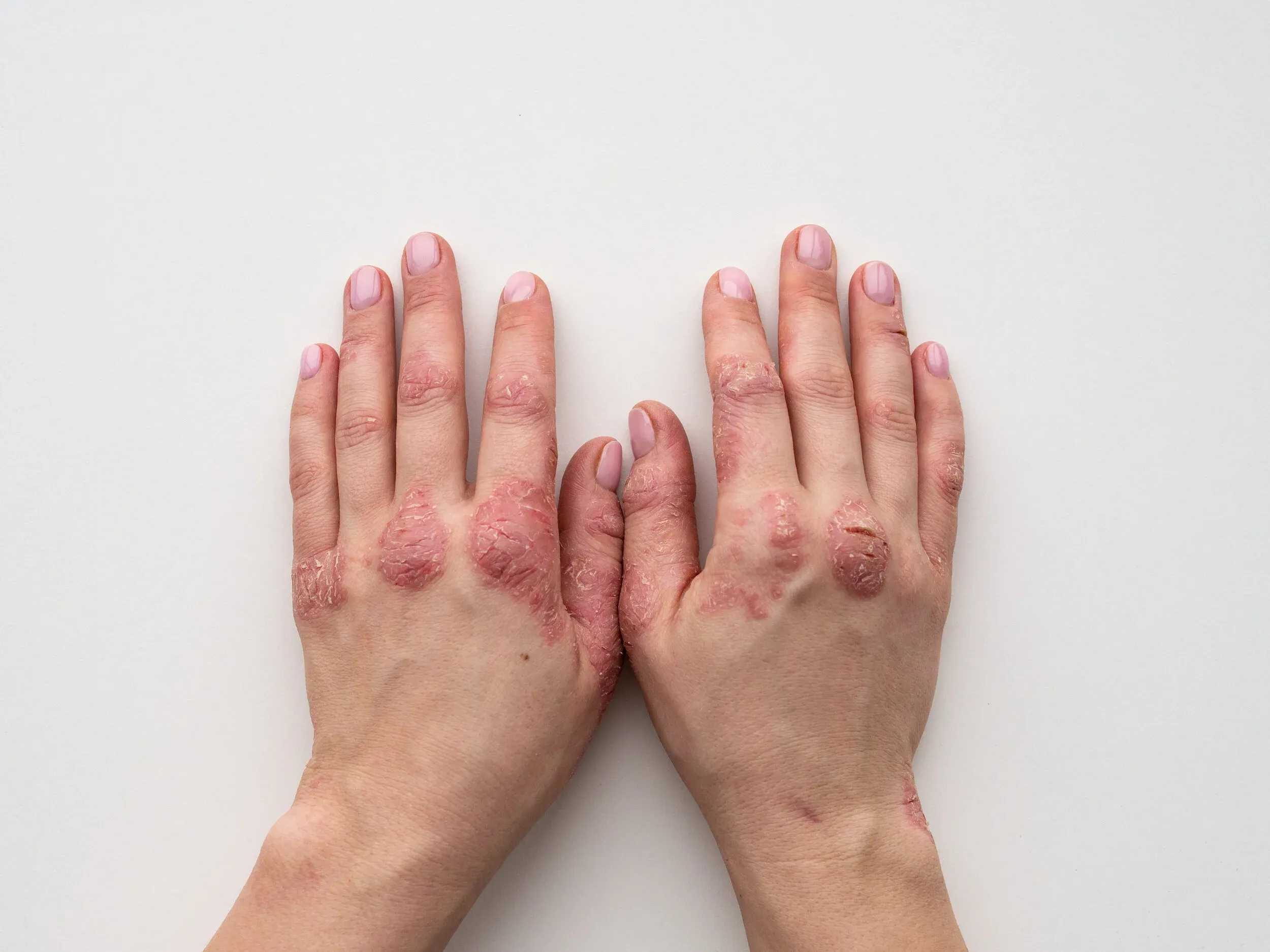
On the thin skin on your knuckles and backs of your hands psoriasis tends to be sharply outlined, raised, and scaled.
If you have light-colored skin the color tends to be pink to red. If you have brown or Black skin, the color tends to be violet, gray, or dark brown with a gray or white scale. After the psoriasis clears flat, darker or lighter skin color can remain for a long time.
On the palms psoriasis can create thick scale and deep, painful cracks that make it hard to bend your fingers or grasp things. It can itch, burn, or be tender on either your palms or the back of your hands. On brown or Black skin where it is hard to see red color, the skin thickening, cracking, tenderness, and having a border helps to show where the psoriasis is active.
On your palms or the soles of your feet you can develop small bumps filled with pus that last or keep coming back, called palmoplantar pustulosis. It may be a related condition rather than ordinary psoriasis plaques. The bumps are usually not infected and sometimes dry up and become brown spots, but new or changing bumps need a check for infection.
This condition seems to be related to smoking. It is different from when tiny bumps appear all over, listed below as an emergency.
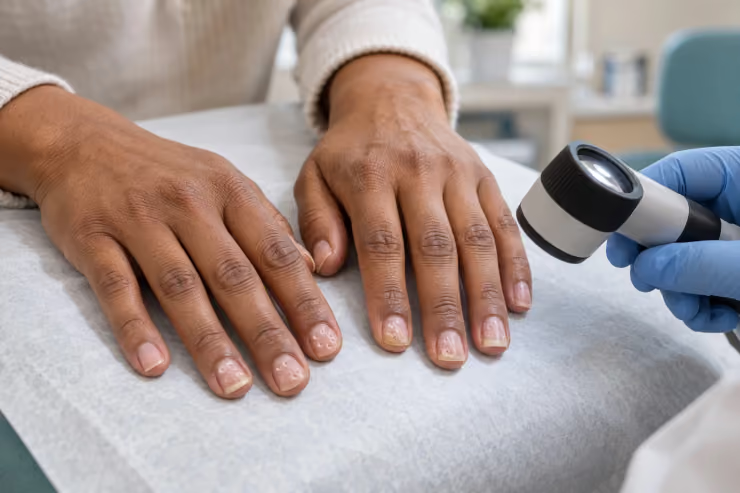
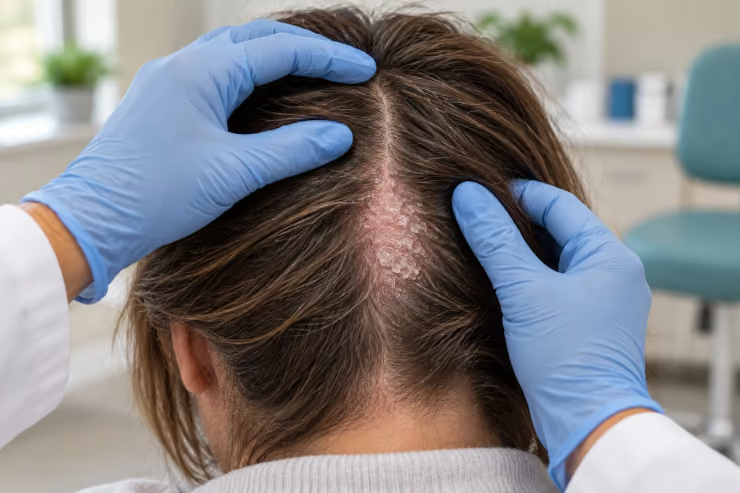
It helps to look at the rest of your skin, scalp, and nails to help us diagnose your rash.
What Else Could It Be?
- Hand eczema: If you have a long-lasting rash on your hands that has thickened, scaled, and cracked, it could be hand eczema.
- Blistering hand eczema: If you develop tiny blisters on your palms or sides of your fingers that itch intensely, it could be dyshidrotic eczema.
- Irritant rash: It could be a rash from repeated wet work, soaps, and cleaning products.
- Allergic contact rash: If you get an allergic rash from chemicals in gloves, or other allergens where they touch your skin, it could be contact dermatitis.
- Fungal infection: It could be a fungal infection on your hands, often on one side, and sometimes with a fungal infection of your feet.
These skin problems can overlap, and you can have eczema and psoriasis at the same time, so sometimes it is hard to tell the difference.
A dermatologist may scrape skin from your hand and look at it under the microscope to check for fungus.
Your dermatologist can also send the scraping to the lab to grow the fungus if needed. They can do allergy patch testing to see if you have a delayed-type allergy. There is no patch test for psoriasis.
If needed, we can do a biopsy and send a small sample of your skin to the lab for diagnosis. Sometimes the lab diagnosis overlaps between hand eczema and palm psoriasis, so it helps to correlate it with what we see when we examine you and hear your history.
Triggers That Matter for Your Hands
There is no single most important trigger for psoriasis. It is different for different people.
On your hands, friction, scratching, and injuries can trigger new psoriasis plaques to form at the site of the injury. Washing your hands and doing wet work can dry out and irritate your hands and create eczema on your hands along with your psoriasis. Sometimes people think their psoriasis flares from wet work, but they are actually developing eczema.
Certain infections, especially strep throat, can trigger or worsen psoriasis. Cold, dry weather can trigger psoriasis to flare. Emotional stress can be related to psoriasis flares and can worsen it.
Certain medications, including one used to stabilize mood, some blood pressure medications, and some medications used to treat malaria, can trigger or worsen psoriasis. If you have been prescribed steroid pills or injections that act throughout the body, stopping them can lead to a flare. It is best to follow the instructions of the prescriber before changing any of these medicines.
The current thinking is that smoking and excess weight may lead to psoriasis or make it worse. This is based on studies of large numbers of people and cannot show what caused your own flare, and we offer help with them without any blame.
Protect your hands when working with wet or irritating substances. After handwashing, moisturize your hands.
A Stepped Plan for Your Hands
Psoriasis on the palms of your hands can be very disabling, even if only a small area of skin is affected. If psoriasis on the hands is disabling or does not settle with skin creams then stronger forms of treatment can be justified. The skin on your palms is much thicker than the backs of your hands, and so often stronger treatment is needed.
We take a careful approach to treating the psoriasis on your hands, stepping the treatment up at the pace your hands need and monitoring how you are doing from the start and at regular intervals.
- Care of the skin and cracks: Use a cream or ointment, free from perfume, daily to help relieve dryness. Clean and apply some petroleum jelly and a dressing to shallow cracks.
- Scale softeners: Prescribed scale softeners such as salicylic acid can be used to soften the thick scale and help other treatments penetrate to where they are needed. Urea can also help soften the thickened skin. Salicylic acid can burn open cracks, so keep it off them, and cover it with a dressing or glove only if told to. A clinician chooses the product and amount for a child, a large area, pregnancy, breastfeeding, kidney or liver problems, or anyone taking medicines related to salicylic acid.
- Prescription skin creams and ointments: Strong steroid creams can be prescribed for the thick plaques of psoriasis on the palms. Ointments are often more helpful. These need to be used for a set time, and then a plan put in place for after stopping them. Vitamin D based creams and more recently nonsteroid creams can be useful alternatives or can be used together with the steroid creams.
- Light treatment: For psoriasis of the hands that does not respond to the above measures, referral can be made to a phototherapy center for medical light treatment. Do not put salicylic acid on your hands just before a session, and follow the light team's timing for it.
- Pills, injections and infusions: There are several medicines that work on the whole body that can be useful. You may respond well to one of these, or you may find that the pus filled bumps on your palms do not respond as well as ordinary plaques. Some of the injected and infused medicines are very specific in the part of your immune system that they treat, and are called biologicals or biologics.
Tanning beds should not be used to treat your psoriasis as the light dose is uncontrolled, and can cause burns and increase your risk of skin cancer.
Work, Daily Life and Your Joints
Psoriasis plaques on the hands can be very painful and can interfere with work, handwashing, dressing, cooking, physical contact, and more. The patches can be very embarrassing and some people avoid shaking hands with others. Please let us know if this is a problem for you, and we can discuss it together in your appointment.
Psoriasis plaques on the knuckles of your hands do not mean that the joints underneath are inflamed. On the other hand, joint inflammation due to psoriasis can occur with very little skin involvement, and it is important to look for it early to help prevent permanent damage to the joints. Therefore, the joints and skin need to be assessed as two separate but related problems, though some medicines treat both.
If your nails are affected by psoriasis then we will look at them and ask about your joints. Please read the article on nail psoriasis.
When to See a Dermatologist
Tell us what your hands do all day, including wet work and gloves, and every cream, ointment or remedy you tried before. Mention all your medicines, including recent steroid pills or injections, and any joint pain or stiffness. Say, too, whether you are pregnant, breastfeeding or planning a pregnancy.
Before any medicine that works throughout the body, we review your health and other conditions. Some of these medicines need tests first and checks during treatment, as our psoriasis service page explains.
Some of these medicines raise the risk of serious infection, and an active infection can delay starting one. Tell us about any current or repeated infection, past tuberculosis or hepatitis, and planned vaccines. Pregnancy, breastfeeding and pregnancy plans change which treatments fit, including some prescription creams, and we choose a child's treatment by age and body site.
Strong steroid creams used longer than directed, or under gloves or wraps without instructions, can thin the skin. The thinner skin on the backs of your hands needs more care than your palms.
Book a visit if hand plaques keep returning or will not settle, or if the diagnosis is uncertain. Painful cracks, trouble with everyday tasks and over-the-counter care that falls short are reasons to come in too.
Seek emergency care right away, rather than booking an appointment, for any of the following. These patterns are rare but can be serious, including on skin where redness is hard to see.
- Severe redness or other inflamed discoloration over most of your body, or skin over large areas that looks burned, whether or not it peels or spreads quickly
- New pus-filled bumps that spread widely, especially with painful skin
- Fever or chills with a widespread painful rash, pus-filled bumps or rapid peeling
- Marked weakness, or feeling very ill, with that kind of rash
- Signs of dehydration with that kind of rash, such as passing much less urine, dark urine, a very dry mouth, dizziness or lightheadedness, or fainting
- Confusion, fainting, fast or difficult breathing, or extreme or rapidly worsening pain with a suspected infection
- Severe eye pain or a sudden change in vision
Contact us promptly about these signs, or get same-day care where the item says so.
- A crack or patch that is increasingly warm, tender or swollen, which calls for same-day care
- Pus, drainage or crusting
- Discoloration spreading outward from a crack or patch, which calls for same-day care and may look darker rather than red on brown or Black skin
- Any of these spreading quickly, or with fever, chills or feeling unwell, which calls for urgent care right away rather than waiting for an appointment
- Joint pain or swelling that persists
- Stiffness after rest, such as in the morning
- A whole finger or toe that swells
- Pain at the heel or the back of the ankle
- Back pain that persists and is worse after rest
- Eye pain or redness, light sensitivity, new blurred vision, or new or newly increased floaters, which need same-day eye or urgent care rather than a dermatology visit
This article offers general education rather than a diagnosis, and it does not replace an examination.
How Our Team Approaches Your First Visit
At your first visit to our South Loop practice, we'll examine your skin, scalp and nails, and we'll ask about your joints, too. Then we'll create an evidence-based treatment plan that's tailored to your work needs. Our physician-led care team includes board-certified dermatologists.
Questions Patients Often Ask
Is It Contagious, or a Sign of Poor Hygiene?
No, hand psoriasis is not contagious, and it doesn't occur because your hands are dirty. In fact, scrubbing your hands will irritate your skin.
Can Changing My Diet Cure It?
No. Unfortunately, no diet cures psoriasis. But if you're an adult and overweight, losing weight can help your treatment work better.
Unless you have celiac disease or blood tests showing gluten sensitivity, there's no evidence that eliminating gluten from your diet is beneficial. If you suspect celiac disease, get tested before you cut out gluten, because cutting it first can hide the result.
Does a Plaque on My Knuckle Mean Arthritis?
Not necessarily. We'll assess both your skin and the joint itself. See the symptoms above that warrant a visit.
Can I Keep Working With My Hands During a Flare?
Often, yes. Work-related skin irritation can be reduced by wearing protective gloves when doing wet work or working with skin irritants, though sweat inside gloves or an allergy to them can make it worse. When we develop your treatment plan, we'll consider how to help you do your job.
Once It Clears, Is It Gone for Good?
No, treatment can help clear your psoriasis for long periods, but it can come back. The duration of clear skin varies.
Talk With Us About Your Next Step
If you're not sure whether you have hand psoriasis, come in. We'll examine your hands and discuss your options. Request an appointment or contact us, and we'll help you decide what to do next.
Individual results and duration of results may vary. Outcomes are not guaranteed.