If you have scaly patches on your face, it could be one of many things.
Your face requires special treatment due to the thinness of the skin there and its proximity to your eyes. This article will help you understand the causes of facial rashes, and we can examine you to find out for sure. One possible cause of a scaly rash on your face is a long term immune-mediated skin condition, psoriasis.
Your immune system sends messages that cause inflammation in psoriasis. Psoriasis is not contagious, nor is it due to poor hygiene.
It is a chronic condition that flares and remits, and while there is no cure there are many ways to treat it. Psoriasis is treated a bit differently on the face, but the same basic principles apply.
Your skin is thinner on your face and you have to worry about getting things into your eyes. Dermatologists think of your face as a high impact area, so even small patches may need additional treatment beyond creams.
Where the Patches Appear
Psoriasis of the face can occur anywhere but favors four areas:
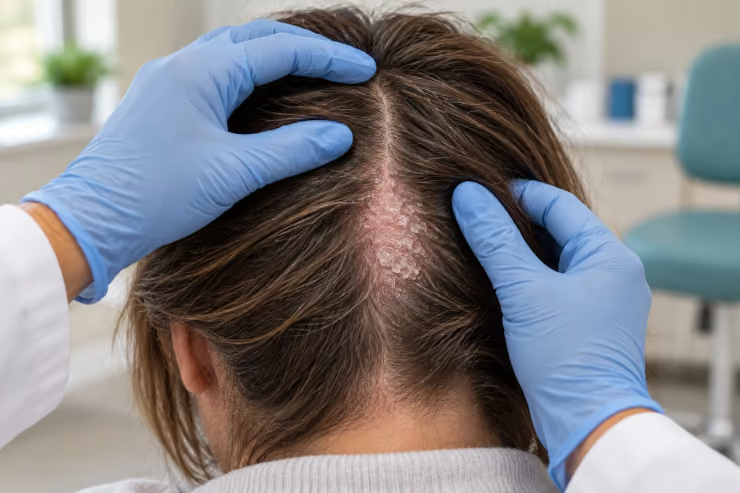
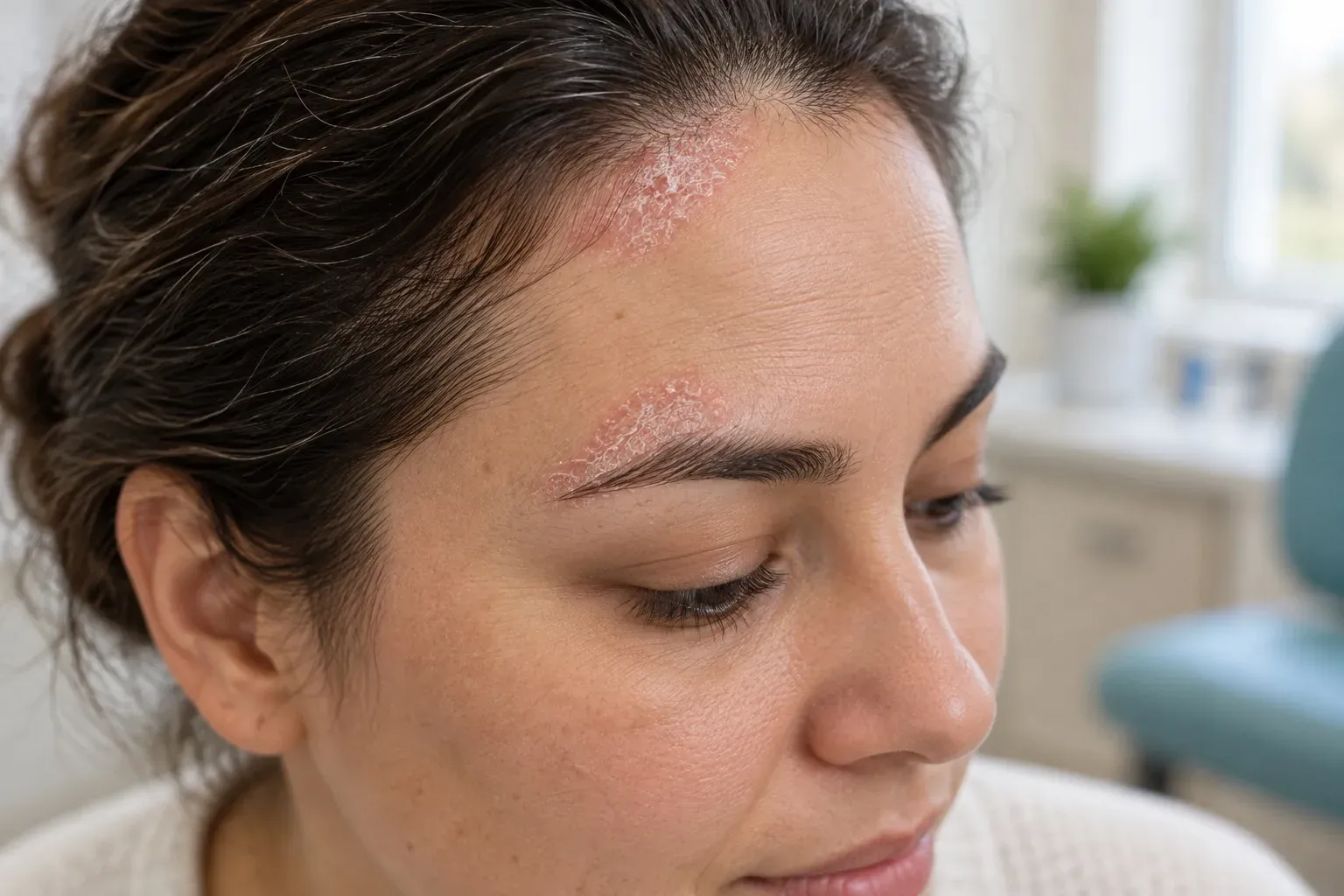
- Hairline and forehead: Along your hairline and on your forehead, where it often has more well defined borders and scale and may be a continuation of scalp psoriasis
- Eyebrows and the sides of the nose: On your eyebrows and the sides of your nose, where it can look similar to seborrheic dermatitis (a flaky rash in naturally oily areas)
- Ears: On your ears, even inside your ear canal
- Eyelids: On your eyelids, where the scale is usually on the outside
Your dermatologist will examine the rest of your skin as well as your nails to look for other signs of psoriasis. If you do not have psoriasis anywhere else it may take a bit more work to figure out what is going on.
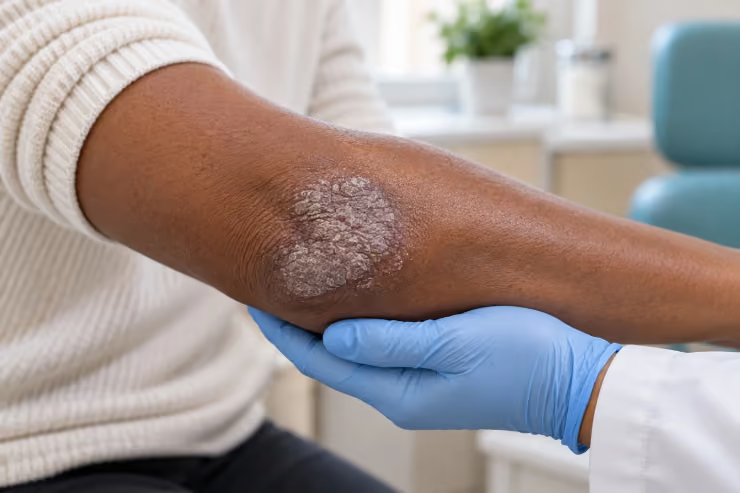
Psoriasis tends to be violet, gray or dark brown on brown and Black skin with pale or gray scale. Lack of redness doesn’t mean there isn’t inflammation, so we will evaluate subtle changes in skin texture, well-defined borders, itch, and other areas involved and any skin color changes left after the rash fades.
What Else Could a Scaly Facial Rash Be?
There are other causes of rashes on your face, however, including:
- A flaky, greasy rash: Seborrheic dermatitis (usually thinner, more greasy or flaky scale and less well-defined borders)
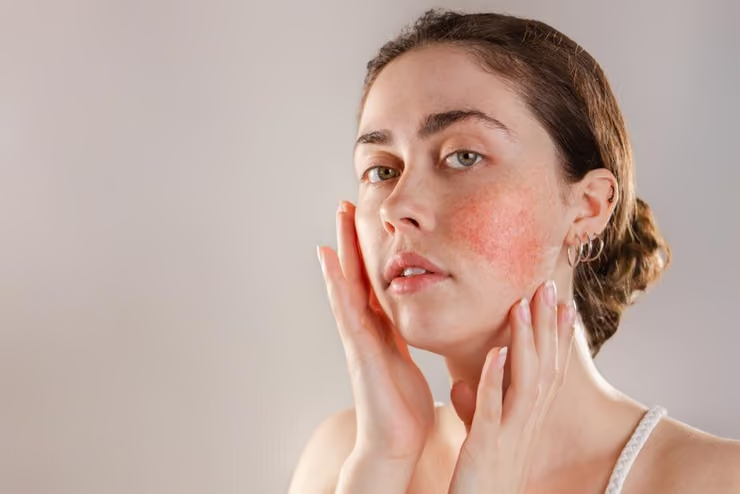
- Flushing and visible vessels: Persistent redness (rosacea) affecting the central face with flushing, tiny blood vessels and bumps; redness is more difficult to see in brown and Black skin
- Itchy, dry patches: Eczema (usually more itchy, dry and less well-defined)
- A reaction to a product: Contact dermatitis (reaction to a cosmetic, cleanser or hair product or something you handle and then touch your face, especially around your eyelids)
- A sun-sensitive rash that can scar: Lupus (often sun sensitive, may leave scars or long term changes in skin color, may be associated with mouth sores or scarring hair loss)
Rosacea has its own set of treatments that your dermatologist can provide. A dermatologist may test for fungal infections if your rash is more one sided or circular, especially if you have used steroid on it.
Biopsies (sampling the skin) are sometimes necessary if your rash is presumed to be psoriasis but is not responding the way we expect. Skin color isn’t enough to differentiate these conditions, even when your skin is brown or Black.
Facial Triggers and Daily Care
Psoriasis can be triggered or exacerbated by scratching, picking, shaving, skin trauma like harsh scrubs or sunburn. If you break out after using a new cosmetic, cleanser or hair product you may have contact dermatitis, which can occur in addition to psoriasis. Other triggers can be stress and dry weather.
Treating your skin gently with a gentle cleanser and a fragrance free moisturizer can help with dryness and irritation, but persistent inflammation may need to be treated with prescription medications. Avoid sunburn as a trigger for psoriasis. Remember that your face and eyelids need gentler treatment, so avoid using strong acids to remove scale, coal tar or anything prescribed for your body on your face.
Why Facial Skin Gets Gentler Medicine
Topical steroids: we try to avoid strong ones on the face as skin on the face is more absorbent to medicine. Sometimes your dermatologist will prescribe a short course of a mild topical steroid. You should never apply a stronger topical steroid which you may be using for your body or scalp, onto your face or eyelids.
You may need separate treatment for your eyelids. Even mild topical steroids can thin your skin if you use them for a long time, so it is important to use the strength and for the length of time that your dermatologist prescribes.
Non-steroidal creams: there are a number of relatively new creams which do not contain steroids and are licensed for use in people with plaque psoriasis. They are not licensed specifically for the eyelids or for use in the eye but they do not exclude use on the face.
Other topical medicines: some topical ointments and creams which are licensed for eczema can be used by your dermatologist to treat psoriasis on the face. These products do not carry a license for use in psoriasis. Their license carries a warning about long-term safety, based on rare reports of skin cancer and lymphoma that they have not been shown to cause.
They are not for continuous long-term use, during light treatment, on infected skin, on a spot that may be precancer or skin cancer, or if illness or medicines have weakened your immune system. They can burn or sting when you use them but they do not thin your skin.
Vitamin-D creams: some vitamin-D creams carry a warning that they should not be used on the face.
There is no ‘best’ cream to use on your face. It depends on how close the patches are to your eyelids, whether we are sure of the diagnosis, your age, whether you are pregnant and whether your skin is tolerant to medicines applied to skin. Whichever cream you are given, your dermatologist will want to see you regularly at first, to monitor how things are going.
Phototherapy: if your dermatologist prescribes light treatment for your skin, this can be used with eye protection, at a dose the treating team sets and adjusts. Your medicines, any history of skin cancer and any sensitivity to light are checked first. We can refer you for this.
Whole body treatments: sometimes your dermatologist may want to discuss using a medicine which works throughout your body, even if you only have a few patches on your face.
This can come in a number of forms, including tablets, injections and infusions. Your dermatologist will discuss this, depending on how much your psoriasis is troubling you, how you responded to other treatments, whether you have other conditions and whether you are or are going to be pregnant.
Eyes, Ears and Everyday Life
Your eyes and your ears: the scales on your eyelids are only on the outside of your eye. There is a link between psoriasis and inflammation inside the eye; if this happens you will need treatment for your eye. Do not put any creams into your eye.
Psoriasis can affect your ears, both the outer ear and the canal itself. Do not try to scrape the scales out of your ear canal.
Psoriasis can affect your joints, wherever your skin patches are. So if you have psoriasis on your face, it is just as important to be aware of the signs and symptoms of psoriatic arthritis as it is if you have psoriasis on your body.
Psoriasis on your face can affect your confidence and your social life. Even if you only have a few patches, it can make you feel self-conscious. It is important to talk to your dermatologist about this.
People with brown or Black skin, like anyone else, can have skin which turns darker or lighter after their psoriasis has gone. These marks can take a long time to fade.
When to See a Dermatologist
At your visit, tell us about every cream and ointment used on your face, including over-the-counter products and prescriptions for other areas. Mention your cosmetics, cleansers and hair products, any eye or ear symptoms and all your medicines. Let us know, too, if you are pregnant, breastfeeding or planning a pregnancy.
Before any medicine that works throughout the body, we review your health and other conditions. Some of these medicines need tests before you start and follow-up while you take them, as our psoriasis treatment page describes.
Some of these medicines raise the risk of serious infection, and an active infection can delay starting one. Tell us about any current or repeated infection, past tuberculosis or hepatitis, and planned vaccines. Pregnancy, breastfeeding and plans for pregnancy change which treatments are appropriate, including steroid-free creams, which are not automatically safe in pregnancy.
Steroid overuse can thin facial skin, leave small visible blood vessels and cause a rosacea-like rash or a rash around the mouth. Strong, prolonged or inappropriate steroid use around the eyes has been linked with raised eye pressure, glaucoma and cataract, mostly in individual case reports.
We would like to see you for facial or eyelid patches that persist, an uncertain diagnosis, pain, cracking or treatment that is not working. The same goes for a rash that flares with sun or leaves scarring.
Seek emergency care right away, rather than booking an appointment, for these patterns. They are rare but can be serious, including on skin where redness is hard to see.
- Severe redness or other inflamed discoloration over most of your body, or skin over large areas that looks burned, whether or not it peels or spreads quickly
- New pus-filled bumps that spread widely, especially with painful skin
- Fever or chills with a widespread painful rash, pus-filled bumps or rapid peeling
- Marked weakness, or feeling very ill, with that kind of rash
- Signs of dehydration with that kind of rash, such as passing much less urine, dark urine, a very dry mouth, dizziness or lightheadedness, or fainting
- Confusion, fainting, fast or difficult breathing, or extreme or rapidly worsening pain with a suspected infection
- Severe eye pain or a sudden change in vision
- A swollen eyelid with pain on moving the eye, trouble moving it, a bulging eye or reduced vision
- Hearing loss in one or both ears that comes on suddenly or over a few days, even if the ear only feels blocked
These signs need prompt attention, so contact us soon. Where an item names same-day care or an eye doctor, go there instead.
- A patch that is increasingly warm, tender or swollen, which calls for same-day care
- Pus, drainage or crusting
- Discoloration spreading outward from a patch, which calls for same-day care and may look darker rather than red on brown or Black skin
- Any of these spreading quickly, or with fever, chills or feeling unwell, which calls for urgent care right away rather than waiting for an appointment
- Scale building up inside the ear canal
- A gradual change in your hearing
- Joint pain or swelling that persists
- Stiffness after rest, such as in the morning
- A whole finger or toe that swells
- Pain at the heel or the back of the ankle
- Back pain that persists and is worse after rest
- Eye pain or redness, light sensitivity, new blurred vision, or new or newly increased floaters, which need same-day eye or urgent care rather than a dermatology visit
This article offers general education and cannot diagnose your skin or replace an examination.
Our Approach to Facial Psoriasis
Our clinicians examine the face, scalp, skin and nails and use the latest evidence to guide treatment choices on the thin skin of the face. We’re a physician-directed team with board-certified dermatologists in the South Loop.
Questions Patients Often Ask
Can I Use My Body or Scalp Prescription on My Face?
No, medications prescribed for the body and scalp are often too strong for the face. Facial medicine should be chosen for the face, and should only be used on the face if prescribed for the face.
Is Psoriasis Linked to Problems Elsewhere in the Body?
Yes, psoriasis is linked to inflammation in the joints (psoriatic arthritis), heart disease, metabolic diseases, fatty liver disease, depression, inflammatory bowel disease, and inflammation of the eye.
This doesn’t mean you have these other problems, it just means that there is a link. The patches on your face are not linked to any specific organ, so make sure to see your primary care provider for routine care and report any new symptoms.
Is Facial Psoriasis Contagious or a Sign of Poor Hygiene?
No, psoriasis is not spread by touching someone or sharing towels with someone who has psoriasis. Psoriasis is not caused by poor hygiene and cannot be cured by scrubbing, “detoxes” or diets.
Can Children Get Facial Psoriasis?
Yes, children can and should be seen to make sure that their facial patches are correctly diagnosed and treated with an age appropriate treatment plan. The limits on how strong a steroid can be used around the face and eyelids matter at all ages.
Can Facial Psoriasis Return After It Clears?
Yes, with treatment many people can go varying long periods of time without psoriasis, although it can always come back. Residual discoloration does not always represent active psoriasis.
Talk With Us About Your Next Step
If you’re unsure if you have psoriasis or want to discuss treatment options, request an appointment or contact us with questions.
Individual results and duration of results may vary. Outcomes are not guaranteed.