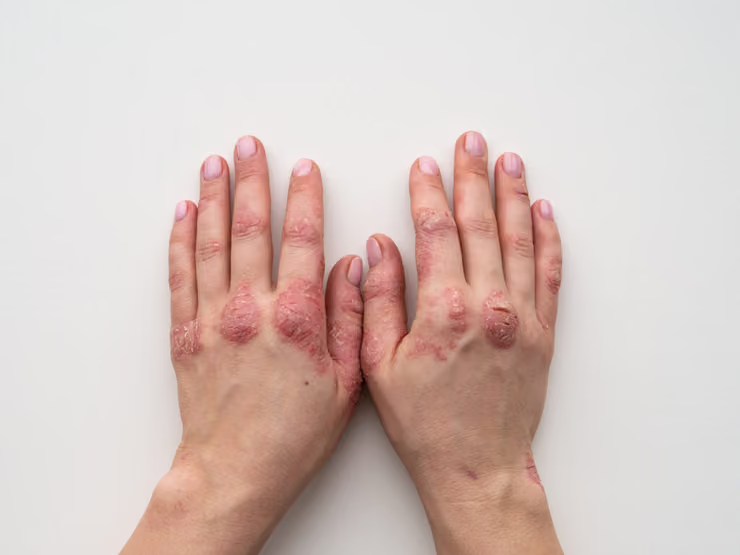
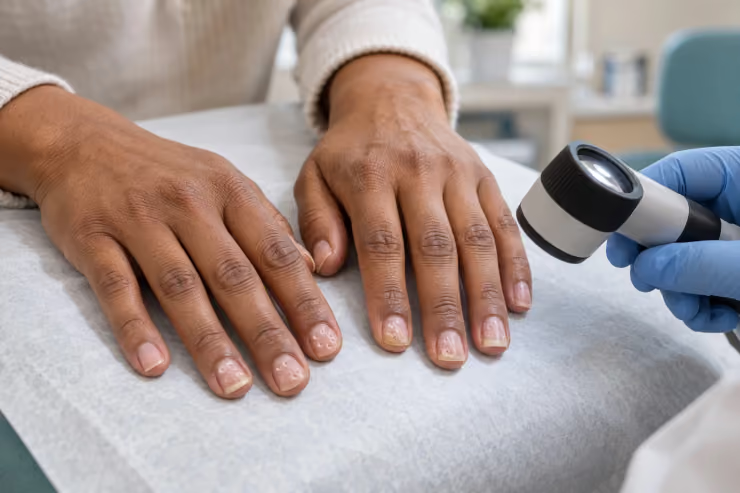
If your skin is brown or Black, scaly patches may appear violet, gray or dark brown. An exam will help confirm what it is.
Psoriasis is a long-term immune system-related condition that triggers inflammation in your skin. This makes skin cells build up faster than they should. It affects all skin tones.
It’s not caused by poor hygiene or anything you can catch. It tends to flare up and calm down.
The good news is that there are ways to control it. The principles of treating psoriasis are the same for all skin tones.
It’s important to know that there are many shades of brown and Black skin. Skin rashes don’t always look the way they’re depicted, especially if the pictures are of people with lighter skin tones. Think of color as one thing to pay attention to, but there are other things to consider, too.
How Psoriasis Looks Across Brown and Black Skin
Things to consider about the whole skin patch:
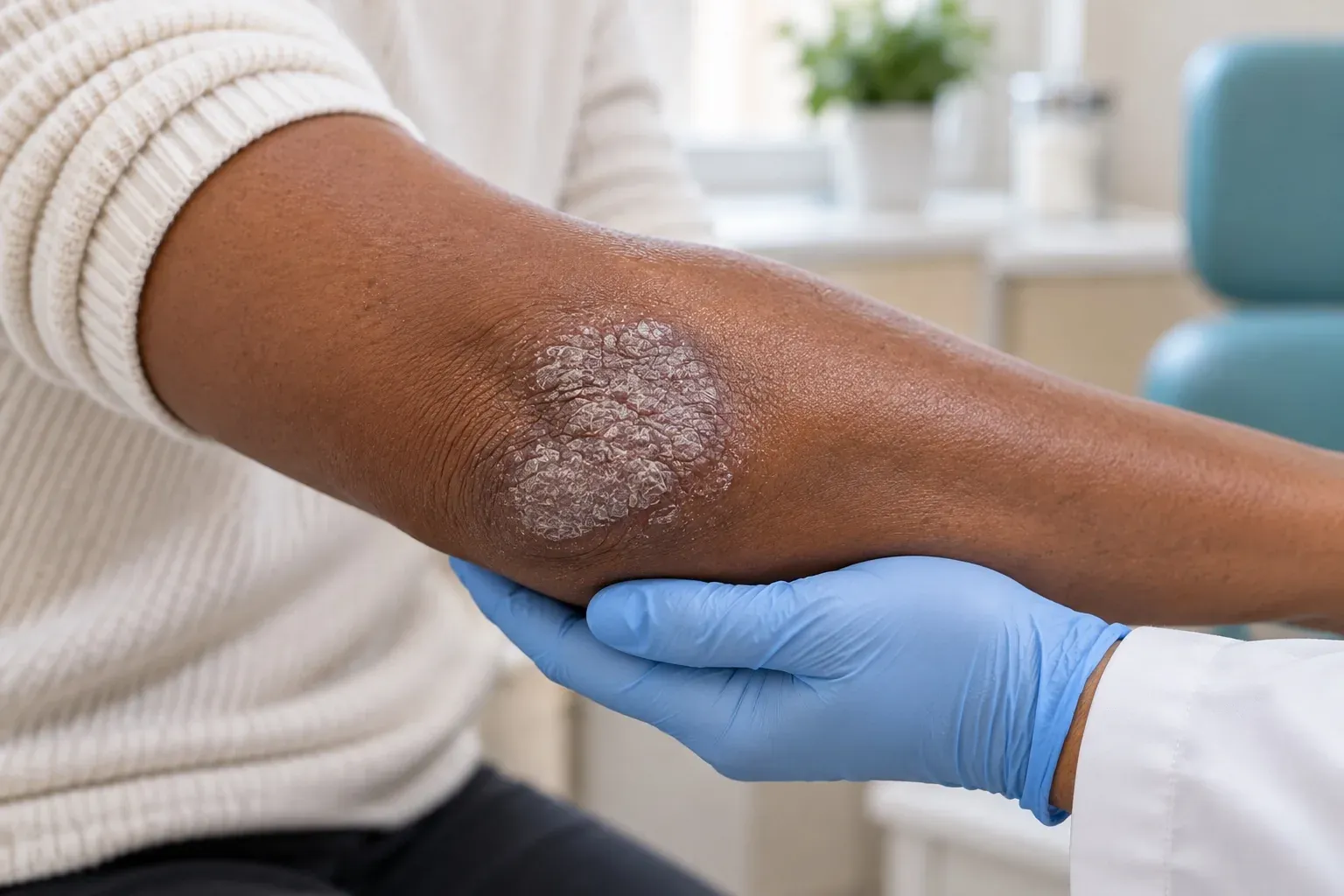
- Color: In darker skin, the psoriasis patch may be more violet, gray or dark brown. It may not look as red or pink as you see online or in a magazine. This depends on your specific skin tone.
- Scale: Darker skin may show the gray-white scale more than the color.
- Edge and thickness: Psoriasis patches usually have a very clear border. When you touch it, it’s usually raised and thick.
- Symptoms: Itching, burning or soreness are just as important to consider as what you can see.
Two telltale signs of psoriasis are a patch that doesn’t go away and has a clear border. Typical psoriasis patches are also raised, and the scale on them tends to stick around, though these signs do not confirm psoriasis and patches in skin folds can be smooth.
Psoriasis of the scalp is a concern for some Black patients, though data is limited and mixed as to whether Black patients get it more often or more severely. Psoriasis of the nails in darker skin tones may look a bit different than skin patches.
Psoriasis of the face may be underestimated in darker skin. If you have psoriasis of your palms, the thickness, cracking and border are more important to notice than the color.
What Else Could These Patches Be?
There are a few skin conditions that may be confused with psoriasis in darker skin. Color is less important in telling them apart.
- Eczema: can appear dark and thickened, especially if it has been scratched for a long time.
- A violet-toned rash: Another inflammatory skin condition called lichen planus can look violet, too.
- A fungal infection: can look scaly and like a ring. You can have it tested for.
- A flaky, greasy rash: Flaky, greasy skin patches, especially on the scalp and face, can be another skin condition called seborrheic dermatitis.
- Lupus: can affect your skin and sometimes leaves lasting color changes or scars.
A dermatologist can help tell the difference by looking at where it is, the scale, the texture, any symptoms, what you may have been exposed to and if there are signs of it elsewhere. Most of the time, an exam will be enough.
Tests, like one to check for fungal infections or an allergy patch test, may be done if needed. Taking a sample of skin (biopsy) isn’t routinely done in darker skin tones, but it may be done if you have an unusual-appearing skin rash.
Why Psoriasis Can Be Missed on Darker Skin
Clinicians partly determine the severity of psoriasis by how red a patch is. It can be harder to see redness in darker skin tones, so your psoriasis severity may not be as obvious. That’s why it’s important to look at other factors, like thickness you can feel, scale, how much of your body it covers, your symptoms and how it’s affecting your life.
It’s also important to note that darker skin tones are underrepresented in pictures used to teach dermatology and studies of psoriasis treatments. This is another reason it’s important for all skin tones to be represented in skin care.
Recent reviews have shown that people with skin of color can have trouble and delays getting their skin conditions diagnosed. Research has also shown that they can face barriers to getting skin care, including getting appointments, transportation, cost and perceived differences between you and the clinician.
When you describe your skin to our team, we’ll make sure to check the texture and thickness, too, no matter your skin tone.
Treatment Options and How They Affect Skin Color
Treatments are the same across all skin tones. Choice of treatment is guided by the location of your psoriasis and how much it impacts you.
Skin color is not a reason to choose stronger treatments. If your psoriasis is in a high impact area (scalp, face, palms and soles, nails, genitals, skin folds) you may need more than creams regardless of your skin tone.
We can tailor creams, ointments, solutions and foams to where your psoriasis is and your routine. Depending on where your psoriasis is and your age, we can find non-steroid options. Research has not compared every treatment in every group, but there is not yet a treatment known to work better for Black and brown populations.
When creams are no longer enough, we can refer you for medical light treatments (phototherapy). We can also discuss medications that treat your whole body given as pills, injections or infusions. We can work with you to start and adjust treatments at a pace that fits the medicine and your psoriasis, with regular check-ins on how it is working, side effects and your questions.
Steroids can lighten skin if used inappropriately or too long. Irritating or burning your skin can cause more marks. Light treatments can tan and darken the skin, so they need careful dosing for darker skin.
Lighter skin may also be a sign inflammation is gone. Skin lightening does not always mean damage from the steroid.
Using tanning beds instead of light treatment is not recommended. Tanning beds increase your risk of sunburn and skin cancer.
Dark Marks, Light Marks and Preventing More
Inflammation can cause darker marks after your patches heal (post-inflammatory hyperpigmentation). It can also cause lighter marks (hypopigmentation). Neither is automatically a scar.
These changes can take 3 to 12 months or longer to fade. Sometimes they can last much longer and may not go away entirely.
Psoriasis doesn't have to be red to be inflamed.
Treat the inflammation and don't pick or irritate your skin. Broad spectrum SPF 30+ sunscreens help reduce pigment problems. Tinted sunscreens with iron oxides add visible light protection.
Marks can be very distressing even when the patches are better.
Even if your skin doesn't appear very inflamed, you can still get psoriatic arthritis. Be aware of the signs of psoriatic arthritis, especially if you have nail changes.
When to See a Dermatologist
Tell us how the patches feel as well as how they look, including itch, soreness and thickness. Mention anything you put on the patches or marks, including lightening or bleaching products and scrubs, and list all your medicines. If your scalp is involved, describe your hair routine, and tell us if you are pregnant, breastfeeding or planning a pregnancy.
Before any medicine that works throughout the body, we review your health and other conditions. Some need tests before you start and follow-up while you take them, as our psoriasis treatment page explains.
Some of these medicines raise the risk of serious infection, and an active infection can delay starting one. Tell us about any current or repeated infection, past tuberculosis or hepatitis, and planned vaccines. Pregnancy or plans for it, breastfeeding, age and body site set the limits on treatment, including some prescription creams; skin color does not.
Book a visit if scaly or thickened patches persist, or if a rash treated as eczema or fungus returns or is not improving. Pain, changes in your hair or nails, and marks that distress you are reasons to come in as well.
Seek emergency care right away, rather than booking an appointment, for the patterns below, which are rare but can be serious. On brown and Black skin, spreading color change may look dark, purple or gray rather than red.
- Severe redness or other inflamed discoloration over most of your body, or skin over large areas that looks burned, whether or not it peels or spreads quickly
- New pus-filled bumps that spread widely, especially with painful skin
- Fever or chills with a widespread painful rash, pus-filled bumps or rapid peeling
- Marked weakness, or feeling very ill, with that kind of rash
- Signs of dehydration with that kind of rash, such as passing much less urine, dark urine, a very dry mouth, dizziness or lightheadedness, or fainting
- Confusion, fainting, fast or difficult breathing, or extreme or rapidly worsening pain with a suspected infection
- Severe eye pain or a sudden change in vision
The signs below need prompt attention: contact us promptly, or get same-day care where an item says so. On darker skin, infection can show as warmth, tenderness, swelling or drainage even when redness is hard to see.
- A patch or crack that is increasingly warm or tender, which calls for same-day care
- Swelling around a patch or crack, which calls for same-day care
- Pus, drainage or crusting
- Discoloration spreading outward from a patch, which calls for same-day care and may look darker rather than red
- Any of these spreading quickly, or with fever, chills or feeling unwell, which calls for urgent care right away rather than waiting for an appointment
- Joint pain or swelling that persists
- Stiffness after rest, such as in the morning
- A whole finger or toe that swells
- Pain at the heel or the back of the ankle
- Back pain that persists and is worse after rest
- Eye pain or redness, light sensitivity, new blurred vision, or new or newly increased floaters, which need same-day eye or urgent care rather than a dermatology visit
This article is general education rather than a diagnosis, and it does not replace an examination.
Psoriasis Care for Every Skin Tone
Our clinicians care for psoriasis on all skin tones. They diagnose your skin condition based not only on its color but also on its texture and your symptoms. They examine not just your skin but also your scalp and your nails.
All treatment decisions are based on up-to-date medical evidence and made under the direction of a physician, a board-certified dermatologist at our South Loop dermatology practice.
Questions Patients Often Ask
Did Hair Care or Washing Less Cause My Scalp Psoriasis?
No. Psoriasis is an immune system disorder, and our dermatologists can help you find a scalp treatment routine that works with your hair-care routine. Psoriasis triggers are the same for all skin tones.
Skin burns are skin burns; the heat and the chemicals involved can inflame and irritate your scalp, which can worsen a psoriasis flare.
Can Psoriasis Be Cured Completely?
No. Although treatment can clear your skin and psoriasis can go into remission for long periods of time, there is currently no known cure for this skin condition.
Does a Dark or Light Mark Mean My Psoriasis Is Still Active?
Not necessarily. Your dermatologist will examine your skin and be on the lookout for signs of inflammation (such as skin thickening) as well as other symptoms. They’ll evaluate your psoriasis patches and any remaining skin marks separately.
Can Creams or Treatments Fade the Marks?
It varies. If your psoriasis patches clear but you’re still unhappy with any remaining skin marks, your dermatologist may recommend treatments aimed specifically at those marks.
Keep in mind, though, that most medical evidence for those treatments comes from people who developed skin marks from other skin conditions or procedures, not from psoriasis. So your dermatologist can’t make promises about how well the marks will clear up.
Harsh skin-lightening products or harsh skin exfoliation can make discoloration worse. And keep in mind that skin bleaching products don’t help spots that are already lighter than your normal skin color.
Talk With Us About Your Next Step
Request an appointment or contact us with any questions about your options.
Individual results and duration of results may vary. Outcomes are not guaranteed.