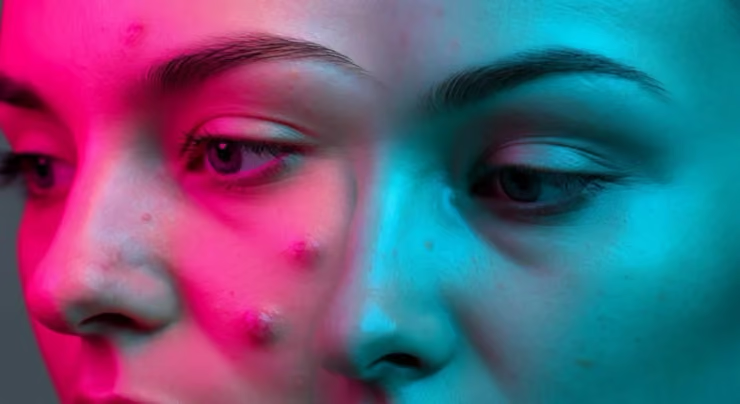
Your red cheeks may be ordinary flushing, or a pattern worth a closer look. This article helps you sort the possibilities, and it does not diagnose you.
Is It Ordinary Flushing, or a Pattern That Returns?
Blushing and flushing are common, and on their own they are not a condition. Ordinary flushing fades once the heat or the hot drink passes. Persistent facial redness and flushing (rosacea) behaves differently, and three features point that way.
- Episodes that keep returning: Flushing recurs often, or lasts far longer than the moment that set it off.
- Color that does not fully fade: Redness on the central face lingers between episodes.
- Company: Burning or stinging, visible small blood vessels, inflammatory bumps, sensitive skin, or irritated eyes and eyelids come with it.
No single sign settles the question, and in most cases no single lab test confirms it. A dermatologist weighs where the color sits, how it behaves over time and what comes with it, then rules out the look-alikes. In the right clinical setting, lasting central-face color that periodically intensifies, or characteristic skin thickening, can be diagnostic.
What Else Can Leave a Face Red
Dryness, swelling or facial redness on its own does not establish the condition. Each of the following is a possibility our medical dermatology team can evaluate, never a verdict from a mirror.
- Acne: Bumps with blackheads or whiteheads may suggest acne, a different condition with different treatment. Acne washes, scrubs and spot treatments can irritate skin reacting for another reason, so self-treating is no substitute for an evaluation.
- Flaky patches: Greasy scale beside the nose or in the eyebrows may suggest a scaling rash (seborrheic dermatitis).
- A reaction to a product: Redness after a new product may suggest an irritant or allergic reaction (contact dermatitis).
- Medicines, steroid creams, or a rash near the mouth: Certain prescriptions and long use of topical steroids can leave lasting redness, as can a separate bumpy rash around the mouth and nose.
- Sun damage: Years of sun can leave the cheeks and nose blotchy, with fine vessels.
- Lupus and other conditions: An autoimmune condition (lupus) and other inflammatory or blood-vessel conditions can show first as a red face.
What the Pattern Can Look Like
How It Behaves Over Time
Lasting color settles on the cheeks, nose, chin or forehead, and symptoms rise and settle in flares. The course varies: in some people vessels or bumps appear over time, while others stay mild or intermittent for years.
Skin thickening, most often on the nose, is uncommon and reported more often in men. The condition is most often recognized in adults between ages 30 and 60, and it occurs at other ages too.
On Deeper Skin Tones
The condition affects every skin tone and is easy to miss on richly pigmented skin. The color may look dusky, brown or purplish, or be hard to see at all. That is why it has historically been recognized less often on darker skin.
Warmth, burning, stinging, sensitivity or swelling may be the main experience, and bumps may be the most visible finding. Describe the sensations to us as carefully as the color.
When the Eyes Are Involved
Rosacea affecting the eyes (ocular rosacea) can come before the skin findings, alongside them, or without prominent facial changes. The eyes may feel dry, watery, gritty or burning, look bloodshot, or turn sensitive to light. Eyelid redness or swelling, recurring styes and blurred vision belong here too.
What Can Treatment Do?
The condition has no known cure, and its causes are not fully understood. Well-chosen treatment can often reduce the color, bumps, discomfort and flare frequency. Improvement, where it comes, takes weeks to months; response varies, and symptoms can return, so maintenance care may follow.
Matching Treatment to the Features Present
We match treatment to the features present rather than applying one standard regimen. In adults, lasting facial redness that belongs to the condition may be treated with approved vessel-narrowing gels such as brimonidine or oxymetazoline. Their effect is temporary, and irritation or rebound redness can occur, particularly with brimonidine.
Inflammatory bumps may be treated with selected anti-inflammatory prescription medicines, applied to the skin or taken by mouth. We start carefully, step up as your skin shows what it needs, and see you regularly to make thoughtful adjustments. Eye involvement may need eyelid care, lubricating drops, prescription therapy, and shared care with an eye doctor (ophthalmologist).
Laser and light-based treatment may reduce visible vessels, with weaker evidence for lasting background redness. It is one part of a plan rather than a requirement, and not every patient needs it. Session counts and outcomes vary by feature, device, skin tone and response, so the laser treatments page carries the detail.
A dermatologist evaluates your skin and sets the plan before any laser or light treatment, and our licensed aestheticians perform it under dermatologist direction. Temporary redness, swelling, discomfort, bruising or crusting can follow, and burns, pigment changes and scarring are less common. Medium to deep skin tones need particular care with device and settings.
What You Can Do Every Day
Wash with your fingertips and lukewarm water, pat dry with a soft towel, and stop anything that burns or stings. Add a moisturizer as tolerated. Gentle care like this can reduce irritation and supports medical treatment rather than replacing it.
Wear a broad-spectrum sunscreen with SPF 30 or higher every day, plus shade and protective clothing when practical. Fragrance-free mineral sunscreens with zinc oxide or titanium dioxide suit some people better. The one you can use every day matters more than the formula.
Sunlight, heat, cold, wind, stress, alcohol, hot drinks, spicy foods, exercise and certain skin-care products are possible triggers, and none is universal. Some people reduce flares by adjusting their own reproducible triggers, found with a simple diary. Think of the diary as a guide to your own pattern: whatever has never affected your symptoms can stay in your life.
When to See a Dermatologist
Redness that returns, lingers or brings company is worth an evaluation. Before any prescription or procedure we review your age, pregnancy or breastfeeding status, allergies and current medications. We also ask about prior reactions, eye disease, heart or blood-vessel conditions, any tendency toward pigment change or scarring, and recent sun or tanning.
Seek prompt medical care for:
- facial redness that is sudden, painful, markedly swollen or one-sided, especially with fever or other symptoms affecting your whole body
- eye pain
- marked sensitivity to light
- blurred or reduced vision
- a persistent feeling of something in the eye
- severe eye redness
The eye signs matter because inflammation of the cornea, the clear front of the eye, can threaten sight.
Call 911 for:
- facial redness or swelling with trouble breathing
- throat or tongue swelling
- fainting
- rapidly worsening symptoms
This article is not a diagnosis, and it does not replace an evaluation of your skin and eyes.
Physician-Led Care for Facial Redness
Our South Loop dermatology practice is led by board-certified dermatologists, and a medical evaluation of your redness comes before any cosmetic step. We lean on evidence when we choose a treatment, and we stay with you as your skin responds.
Questions Patients Often Ask
Does Blushing Easily Mean I Will Develop This Condition?
Not necessarily. Many people blush readily for a lifetime and never develop lasting color, vessels or bumps.
Is Laser Treatment Required for the Redness?
No. It is one option for visible vessels and selected cases of lasting redness, while many plans rest on prescription treatment and daily care.
Should I Keep Using My Skin-Care Products Before the Visit?
Often, yes. Keep your routine and bring the products, because what you apply is part of the picture.
Does It Appear Anywhere Besides the Face?
It varies. Changes on the ears, scalp, neck or upper chest are uncommon, and they deserve evaluation because they may point to another condition.
Talk With Us About Your Next Step
If your face has been red for weeks and the uncertainty is wearing on you, an evaluation is the next step. Our dermatologists examine your skin and eyes, sort the possibilities with you, and lay out options that fit your features. Request an appointment with our Chicago team, or contact us with a question.
Individual results and duration of results may vary. Outcomes are not guaranteed.