Little blisters on your hands or feet can often be calmed. Hand and foot blisters have several possible causes, so the first step is an accurate diagnosis.
What It Looks Like
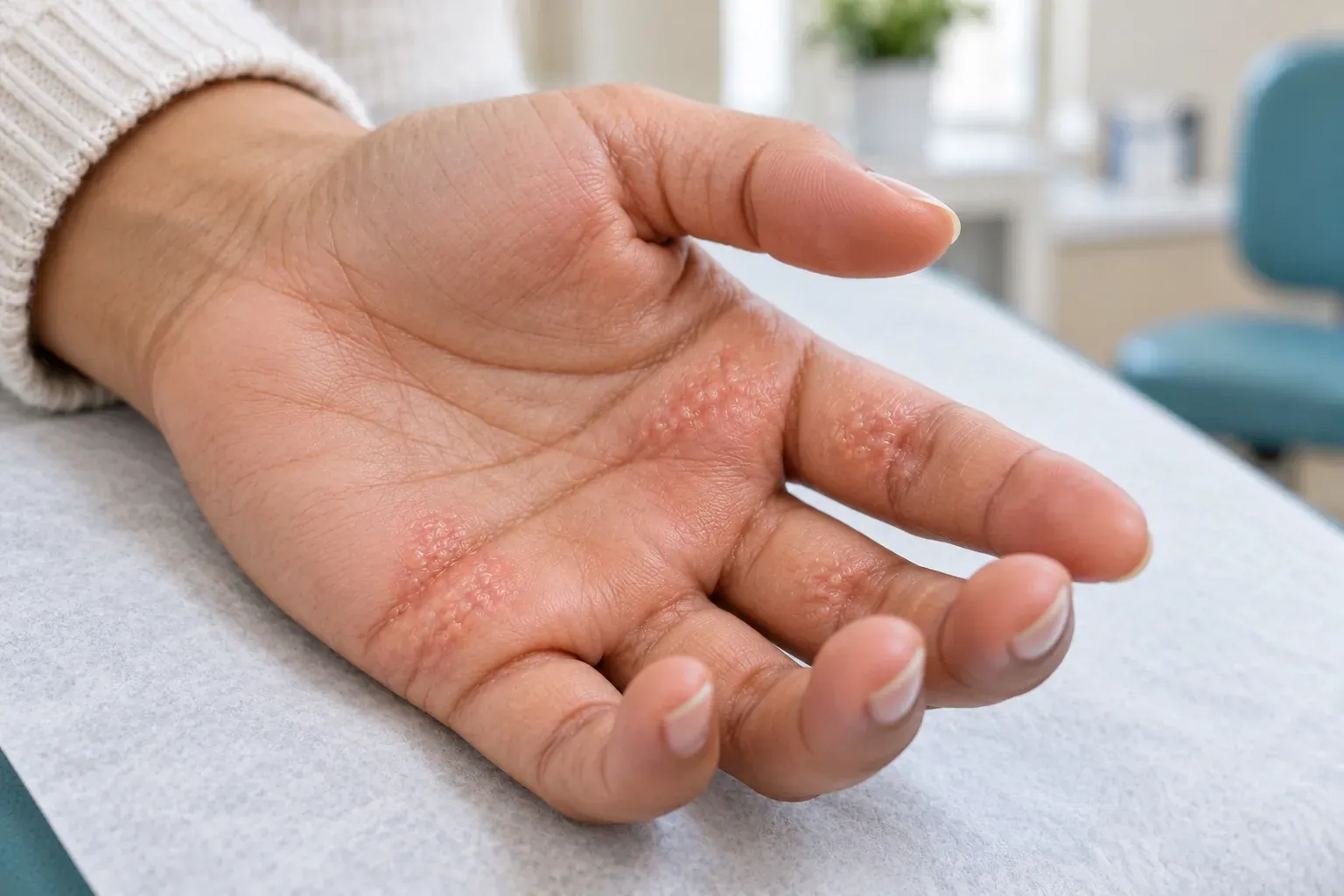
The blisters on the hands can be one form of eczema. They are tiny but deep-seated and very itchy. They occur on the palms, sides of fingers, or on the soles of the feet.
This type of eczema usually appears on both hands or both feet. The area will be itchy and may burn. Often the skin will peel and sometimes crack.
The name of this form of eczema is dyshidrotic eczema, dyshidrosis, or pompholyx.
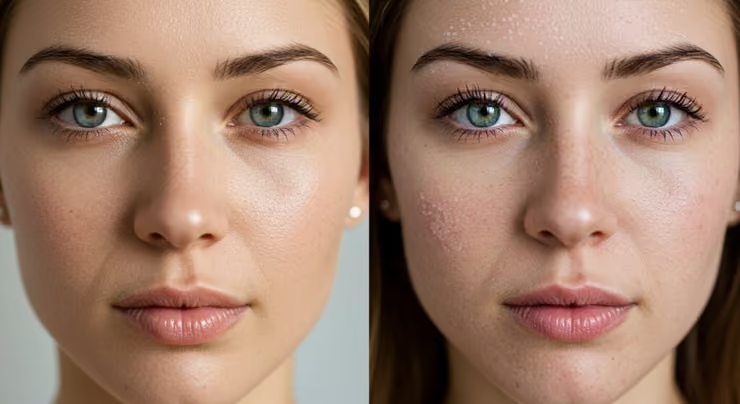
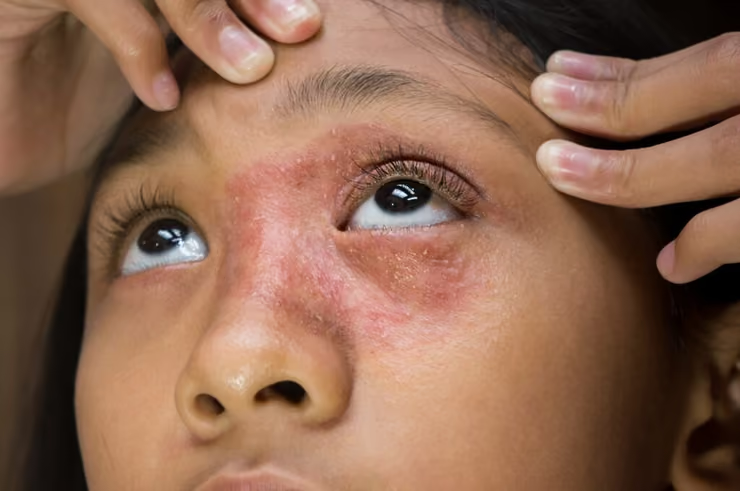
If you have brown or black skin, redness of inflammation can look brown, purple or gray. Pay attention to swelling, warmth, itchiness and any change of your normal skin color.
It may take months or years for darker skin color to resolve and lighter areas may return to your normal skin color. These changes in color do not by themselves indicate that the eczema is active. However, if the lighter areas of skin don’t go away, ask for a diagnosis.
What Else Causes Itchy Blisters on Your Hands?
There are other skin diseases that appear as blisters on the hands or feet. Each one is treated differently and some are contagious. It is important to get the right diagnosis for your skin problem.
- A rash from something your skin touched (contact dermatitis): Another form of eczema, contact dermatitis, can look similar and can coexist with dyshidrotic eczema. What you are handling, where else you have skin rash, and a skin patch test for allergy can help to clarify the diagnosis.
- A fungal infection (ringworm): A fungal infection of the hands or feet, ringworm, can cause scaling, a spreading infection, nail infection or blisters. If the blisters are on one hand, ringworm is more of a concern, though it can still be eczema. A microscopic exam or lab culture of a skin scraping can diagnose fungal infection.
- Tiny mites in the skin (scabies): Infestation of the skin by a microscopic mite is scabies. It usually causes severe itching at night, and tiny burrows or itchy skin on the hands (especially between the fingers) and wrists and other areas of the body. Scabies is contagious. A microscopic exam of a skin scraping can show the mites or eggs, however, a negative skin scraping does not rule out scabies.
- Pus-filled bumps on thick, scaly palms or soles (palmoplantar pustulosis): Palmoplantar pustulosis causes pus filled bumps on thick, scaly skin on the palms or soles. It is often painful. The pus in the bumps is not caused by germs, so when the blisters of dyshidrosis become cloudy, it is not necessarily infected. An exam by your doctor is the best way to tell the difference between these two skin problems.
- A viral illness (hand, foot and mouth disease): Hand, foot, and mouth disease is a viral infection that starts with a fever, mouth sores and a skin rash on the hands and feet. It is more common in children. The rash is usually less itchy than dyshidrotic eczema. The entire clinical picture will help your doctor to distinguish between these two diseases.
- A blistering immune condition (such as bullous pemphigoid): There are other blistering diseases, such as bullous pemphigoid, that can mimic the hand eczema. If you have larger, tense blisters, blisters elsewhere on your body, or your skin disease does not follow the usual course, your doctor may take a small sample of your skin and order blood tests.
- A bacterial skin infection (impetigo): Impetigo is a skin infection caused by bacteria. It causes fragile blisters that break open and leave crusts on your skin. If your skin spots are spreading, crusting, or leaking, please be examined by your doctor.
Your doctor will examine your skin, and if necessary perform a test, to make the correct diagnosis.
Causes and Triggers
The cause of dyshidrotic eczema is not entirely clear. The name refers to sweat glands, however, we now know that the problem is eczema developing within the skin, and the sweat glands are normal. People with dyshidrotic eczema may have other forms of eczema or may not.
- Sweat: Moisture on your skin can exacerbate dyshidrotic eczema.
- Environment: For some people, warm weather with sweating and humidity triggers their dyshidrosis. For others, cold and dry weather causes their eczema to flare.
- Stress: Stress can trigger or exacerbate dyshidrotic eczema, however, it is not the cause of this skin problem and decreasing stress will not cure the disease.
- Allergy: Allergy to metals (nickel, cobalt, or chromium) or to personal care products can contribute to dyshidrosis. If patch testing for allergy is positive, it must be correlated with your contact exposures to determine whether you are having an allergic reaction. Allergy does not explain every flare of dyshidrosis.
- Athlete's foot: A fungal infection of the feet (athlete's foot) can trigger blisters on the hands. Once the athlete's foot is confirmed and treated, the dyshidrotic eczema may improve, but we look at the blisters on the hands separately, since they may or may not be a fungal infection themselves.
- Some medicines: A few medicines and infusions have been linked with flares.
We know that not all these things will trigger a flare in everyone and finding the things that do cause a flare for you can help to prevent flares.
Home Care for a Flare
When you have a flare, cool compresses can help with the itch. Wash your hands and feet with a mild fragrance free cleanser and gently dry off. Apply a fragrance free cream or ointment to your hands and feet.
Try not to scratch your hands and feet because the risk of developing an infection is increased when the skin is broken.
Remove rings from your fingers so that water and cleanser don't get trapped under them. Wear waterproof gloves lined with cotton for wet work but avoid wearing them for long periods as the sweating in the gloves can cause a flare. To keep your feet dry, wear moisture wicking socks and don't let your feet overheat.
Confirming the Diagnosis
When you visit us, we'll ask what your hands and feet have been in contact with, when your eczema flares, what medicines you're taking, if you have athlete's foot or get eczema in other places. We'll examine your hands and feet and look at other parts of your skin too. This will help us to decide what testing to do.
If we think that your dyshidrotic eczema might be caused by a contact allergy, we might order patch testing. This is particularly helpful when the eczema doesn't go away or the eczema is unusual.
We might scrape the skin to look for fungus or mites. If the blisters are large, tense, unusual or widespread, we might take a small piece of skin (a biopsy) to send to the laboratory.
How Dyshidrotic Eczema Is Treated
We use a stepped approach to treating dyshidrotic eczema, like a ladder, stepping up a level at a time. When you start a treatment for dyshidrotic eczema, we'll see you regularly to monitor how you're doing and to decide with you what to change.
The first treatment we'll usually prescribe is a steroid cream or ointment. The skin on your palms and soles is thick so we need to use a steroid of the right strength.
We'll tell you where to put the steroid and for how long. We'll also tell you if you need to cover the steroid. Sometimes, we'll use a medicated soak to treat a flare or, if the blisters are very large, drain them with sterile instruments.
There are also nonsteroid prescription creams and ointments that may be able to help if your dyshidrotic eczema doesn't go away. For people with severe dyshidrotic eczema that doesn't respond to creams and ointments, a dermatologist may suggest using medicines that act throughout the body.
Some of these prescription medicines, whether creams, ointments, pills or injections, are not approved for use in dyshidrotic eczema but are approved for other types of eczema or other conditions. We will always tell you, before you start, when a medicine is being used for something other than what it has been approved for.
These medicines require special precautions and some require screening and monitoring. We'll review the precautions and any screening and monitoring with you before we prescribe the medicine for you.
If you develop an infection while you have dyshidrotic eczema and the infection is confirmed, we'll treat the infection. But we don't routinely prescribe antibiotics or antifungal medicines for dyshidrotic eczema.
When to See a Dermatologist
The signs below are reasons to come in rather than wait out another flare.
If you notice any of these, seek same-day care instead of treating the blisters at home, without waiting for a routine appointment. Call emergency services for severe or rapidly worsening illness, such as confusion, trouble breathing, or fainting or collapse. For an eye sign, go to an emergency department when same-day specialist care is not available.
- Blisters along with a fever
- Painful redness, darkening or swelling that spreads quickly
- Blisters or sores that spread quickly
- Feeling markedly unwell along with the blisters
- Clusters of painful blisters or punched-out sores, which can be a herpes infection spreading through skin with eczema (eczema herpeticum)
- Sores near the eyes, eye pain, blurred or reduced vision, light sensitivity, a new red eye, unusual watering or discharge, or any other eye symptoms along with these blisters or sores
Contact us promptly if you notice any of these, and seek same-day care if a fever comes with any of them. Seek same-day care even without a fever if the skin is getting hotter, more painful or more swollen, or its color change is spreading.
- Blisters that look infected
- Honey-colored crusts
- Pus
- Redness, darkening or another new color change that is spreading
- Warmth
- Pain that is increasing
- Swelling that is increasing
- New blistering, or blisters you are unsure about
- Outbreaks that keep coming back
- Blisters that are not responding to treatment
- Difficulty walking or using your hands
- Itch or pain that disrupts your sleep or work
- Large, tense blisters, which we assess before any draining
Tell us what your hands and feet touch, including metals, tools, gloves and personal-care products. Mention any athlete's foot or rash elsewhere, anything applied to the blisters and for how long, and any known allergies. Also mention any medicine or infusion started recently, without stopping a prescribed medicine on your own, and whether you are pregnant or breastfeeding.
This article offers general education and cannot diagnose you or replace an examination.
Physician-Led Eczema Care
Eczema falls under the umbrella of medical dermatology, which we treat at our South Loop dermatology practice. Based on evidence and what we find, we look for the cause of your eczema and treat it accordingly. Our medical dermatology care is physician-led, and each of our dermatologists is board certified.
Questions Patients Often Ask
Does Dyshidrotic Eczema Have a Cure?
No. Not at this time, but we can help you control the symptoms. Some people only have one episode, while others experience recurring or persistent flares at unpredictable times.
We can help you identify and avoid triggers, and there are treatments to help prevent flares, but there’s no way to be certain the blisters won’t return.
Is Dyshidrotic Eczema Contagious?
No, dyshidrotic eczema isn’t contagious. However, there are other conditions that look similar that are contagious, so it’s important to be properly diagnosed.
Should I Pop the Blisters?
No, it’s best not to pop dyshidrotic eczema blisters because you run the risk of introducing an infection. Keeping the blisters intact and clean is best. However, it can be helpful for a clinician to drain very large blisters, so contact us if you have large, tense blisters.
Can a Low-Nickel Diet Help?
Not necessarily. In certain cases, if you have persistent eczema and a confirmed nickel allergy, your clinician may put you on a low-nickel diet. Be sure to follow it only under supervision, as the research on low-nickel and low-cobalt diets (even weaker evidence exists for the latter) is limited.
It’s not recommended to limit your diet without a confirmed allergy and proper supervision, as you may not get the nutrition you need, especially if you’re a child.
Do Antihistamines Help the Itch?
Not necessarily. Older guidelines for treating dyshidrotic eczema included taking antihistamine pills. Current research, mostly done in other types of eczema rather than dyshidrotic eczema, suggests antihistamines don’t routinely help control itch, and whether they prevent flares is uncertain.
Some antihistamines can make you drowsy, but they may not help you sleep and can make you less alert the next day. (They do have a place in treating hives, however.)
Talk With Us About Your Next Step
If you keep getting blisters on your hands or feet, it’s a good idea to get an exam. We can help you figure out what you have and work with you on your options and a treatment plan. Request an appointment or send us a question to get started.
Individual results and duration of results may vary. Outcomes are not guaranteed.