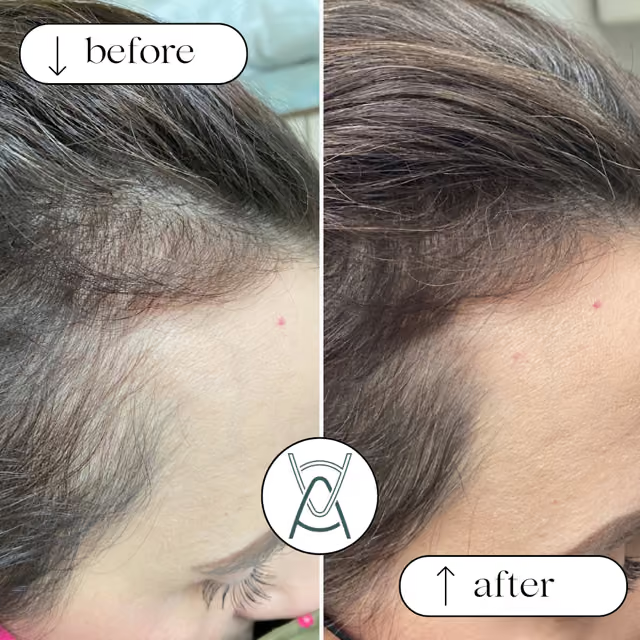
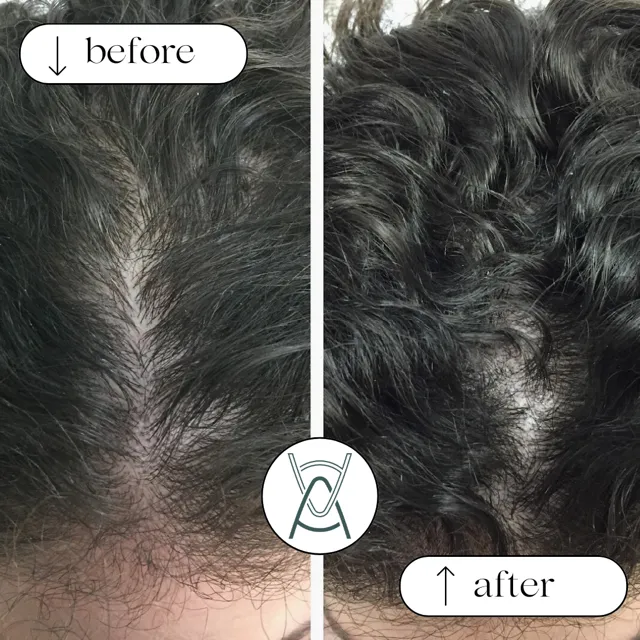
The best thing we can do is give you a realistic idea of what a result can look like. When PRP works, it is a filling in of the thinning areas.
The degree to which this will happen depends on how many hair follicles are still active in those areas. It will be about 6 months before you can fairly compare pictures to determine your level of regrowth using platelet-rich plasma (PRP).
What a Realistic After Photo Shows
It will be more of a filling in of existing areas than regrowing a hairline. What this means in practical terms is that the areas that are thinning can have more hairs in them, resulting in less scalp visibility. It can look like a narrowing of the part or more coverage on the crown.
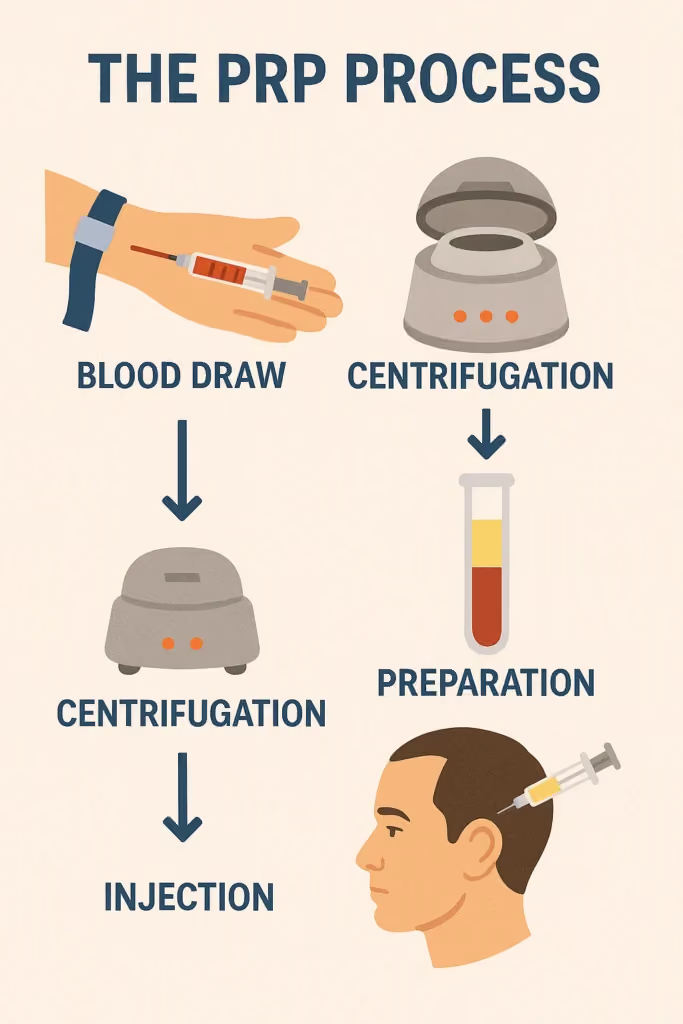
Areas that are completely bald or scarred are less likely to fill in. Keep in mind that this is your blood being drawn from your arm, concentrated and injected back into the thinning areas of your scalp.
Where Does Change Show, and for Whom?
PRP can be very useful in areas that are thinning that still have active hair follicles. We cannot guarantee regrowth for every patient as each person's response to treatment varies.
Men in the early stages of male pattern hair loss who have thinning hair (shorter and thinner hairs growing out) on the crown or in the middle of their head may get more density. Women who, after evaluation by our physicians, are deemed to have female pattern hair loss (often widening of the part) may get improvement.
Results at the front of the scalp or the temples, where the hairline has receded, are less predictable. If you are shedding all over, there are many possible causes of that. You should have a hair loss evaluation first to make sure that you don’t have a condition that won’t respond to PRP and needs to be treated separately.
Some of those conditions are nutritional deficiencies, thyroid or hormone problems, medication-related shedding, or inflammatory diseases of the scalp.
A scarring form of hair loss needs to be diagnosed and treated quickly to get the inflammation under control. You may not recognize it yourself, so scalp burning, tenderness, itching, scaling, or smooth and shiny patches are reasons to be evaluated first. PRP is not a substitute for that.
Our Treatment Calendar
What to Expect in Terms of Timing for PRP
- Series of four: Treatments are one month apart. You may notice a reduction in shedding.
- After the series: You may notice shorter, thinner hairs beginning to grow in the thinning areas.
- Six-month assessment: 6 months after beginning PRP is when we evaluate regrowth.
- Maintenance: After that, maintenance treatments are every 3-6 months, based on your response and goals.
You will be seen regularly during the series of 4, and after.
Why Does Change Take Months?
Hair grows slowly and in cycles. It will take months for it to grow long enough to see a difference in your pictures. So, it won’t be until about 6 months after beginning PRP that you can fairly compare before and after pictures.

How to Read a Before and After Photo
What To Look for in PRP Before and After Photos
- Timing: Know how much time has elapsed since the first treatment. What number treatment is the second picture?
- Other treatments: What other treatments, if any, is the patient using for their hair loss?
- Lighting: Make sure the light is the same in both pictures. Overhead light will emphasize scalp visibility.
- Angle and distance: Make sure the pictures are taken at the same angle from the same distance.
- Hair state: Hair should be dry in both pictures, parted the same way, about the same length, and not have any styling product or fibers in the hair.
If you see dramatic changes after only a few weeks, be cautious. If you see completely bald areas filling in, be cautious. If the pictures look filtered or edited in any way, be cautious.
Make sure there are more than two time points in the pictures. If possible, look at examples that have the same hair type and texture as you, and with the same pattern of hair loss.
Keep in mind that different practices may use a different number of treatments or do them at different intervals. We do a series of 4 treatments. If a detail isn’t clear in the pictures you’re viewing, ask.
What an After Photo Cannot Tell You
Also, know if the patient is on any medications along with the PRP treatments. The changes in the after photos may be due to medications, or may be due to a combination of the PRP and the medication.
PRP is meant to be used as an additional treatment along with other treatments, such as minoxidil, finasteride, or spironolactone. It is not meant to replace them. Part of a comprehensive, personalized hair restoration plan will dictate whether or not those other treatments are appropriate, based on your diagnosis and health history.
It isn’t possible to show how long results last. If hair loss is from pattern hair loss, it tends to progress over time, which is why maintenance is part of the plan. After six months, we will know how well your hair responded to the PRP and plan any maintenance, based on your goals.
It isn’t possible to know how you will respond to PRP for hair loss. How well your hair loss responds depends on how the hair follicles are doing in the areas where your hair has thinned. The best photo to show what you can expect is a before-and-after photo of you, comparing the areas of your thinning hair to what they looked like before you started your PRP treatments.
Before You Book
Tell us about every medicine you take, including prescription blood thinners and medicines that affect how platelets work, such as aspirin. Also mention a bleeding, clotting or liver problem, a low red blood cell count (anemia), or any history of cancer. A condition or medicine that weakens your immune system, or any other medical condition, likewise gets individual review rather than an automatic no.
Never stop aspirin, a prescription blood thinner or another prescribed medicine unless its prescribing clinician says so. We may ask you to briefly pause other nonprescription anti-inflammatory pain relievers around a treatment.
We postpone PRP during pregnancy, because safety information is limited, and during an active infection on the scalp or anywhere in the body. A bleeding or platelet disorder, including a low platelet count or poorly working platelets, can also delay or rule it out.
A significant uncontrolled illness, a significant clotting problem, or liver disease that affects clotting can do the same. So can an untreated or suspicious spot in the treatment area.
Expect tenderness, redness, swelling and pinpoint bleeding at the injection sites, which settle quickly, and possibly a headache for 1 to 3 days. Less common are infection, bruising or blood collecting under the skin, lingering inflammation at the injection sites, and injury to nearby tissue. Rarely, people prone to pigment change develop temporary darkening of the skin after inflammation.
PRP is not specifically FDA approved for treating hair loss.
After a treatment, contact our office promptly if you notice any of these:
- pain at the injection sites that is getting worse instead of better
- redness that is spreading
- warmth at the injection sites
- swelling that is increasing instead of settling
- pus or other drainage from an injection site
- fever or chills
- a lump or bruise at an injection site that keeps growing
- a headache that does not settle within a few days
- darkening of the skin at the injection sites that is not fading
Do not wait for our office to reopen if symptoms are spreading quickly, pain is severe, or you have a fever and feel unwell. Go to urgent care or an emergency department, and do the same for a sudden severe headache or any change in your vision.
This article cannot diagnose your hair loss or replace an evaluation.
Our Approach to PRP
Our dermatology practice in Chicago’s South Loop is part of the Northwestern Medicine Physician Network. We base our recommendations on the best available evidence and are committed to explaining what you can expect from your PRP treatments clearly. We offer physician-directed PRP treatments for hair loss after a medical evaluation.
Questions Patients Often Ask
Can PRP Fill In a Receded Hairline?
Not necessarily. Results along the hairline are less predictable. If improving the appearance of your hairline is important to you, please discuss this with our doctors at your evaluation.
Is It Normal to See No Change During the Series?
Yes. It will be too early to evaluate your results when you are still having your series of treatments. You can evaluate your results when six months have passed since starting your PRP treatments.
To get the most from comparing your photos, be sure to keep the conditions consistent between your photos.
Should I Take My Own Progress Photos?
Yes. It will help us and you to evaluate your results if you take photos before your first treatment and then keep the conditions consistent for each photo you take. Be sure to bring your photos with you when you come in to see us.
Will My Results Look Like the Photos I See Online?
It varies. Results vary from patient to patient, since they depend on the status of your hair follicles. When you come in for an evaluation, we can compare what we see on your scalp to the photos you like.
Talk With Us About Your Next Step
If you aren’t sure whether PRP treatments are right for you, we encourage you to come in for an evaluation. Knowing the cause of your thinning hair is important, because some causes of hair loss will continue to shrink or destroy your hair follicles. Getting a diagnosis of your hair loss now may help you keep your options open.
Request an appointment to see one of our Chicago dermatologists or contact our office if you would like to discuss what you can realistically expect from PRP treatments for hair loss.
Individual results and duration of results may vary. Outcomes are not guaranteed.