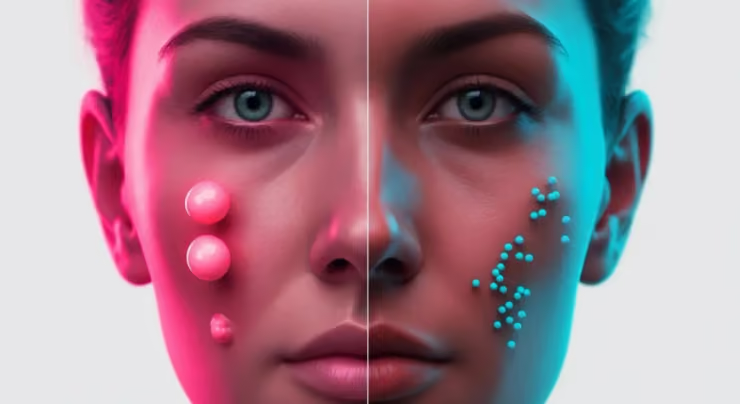
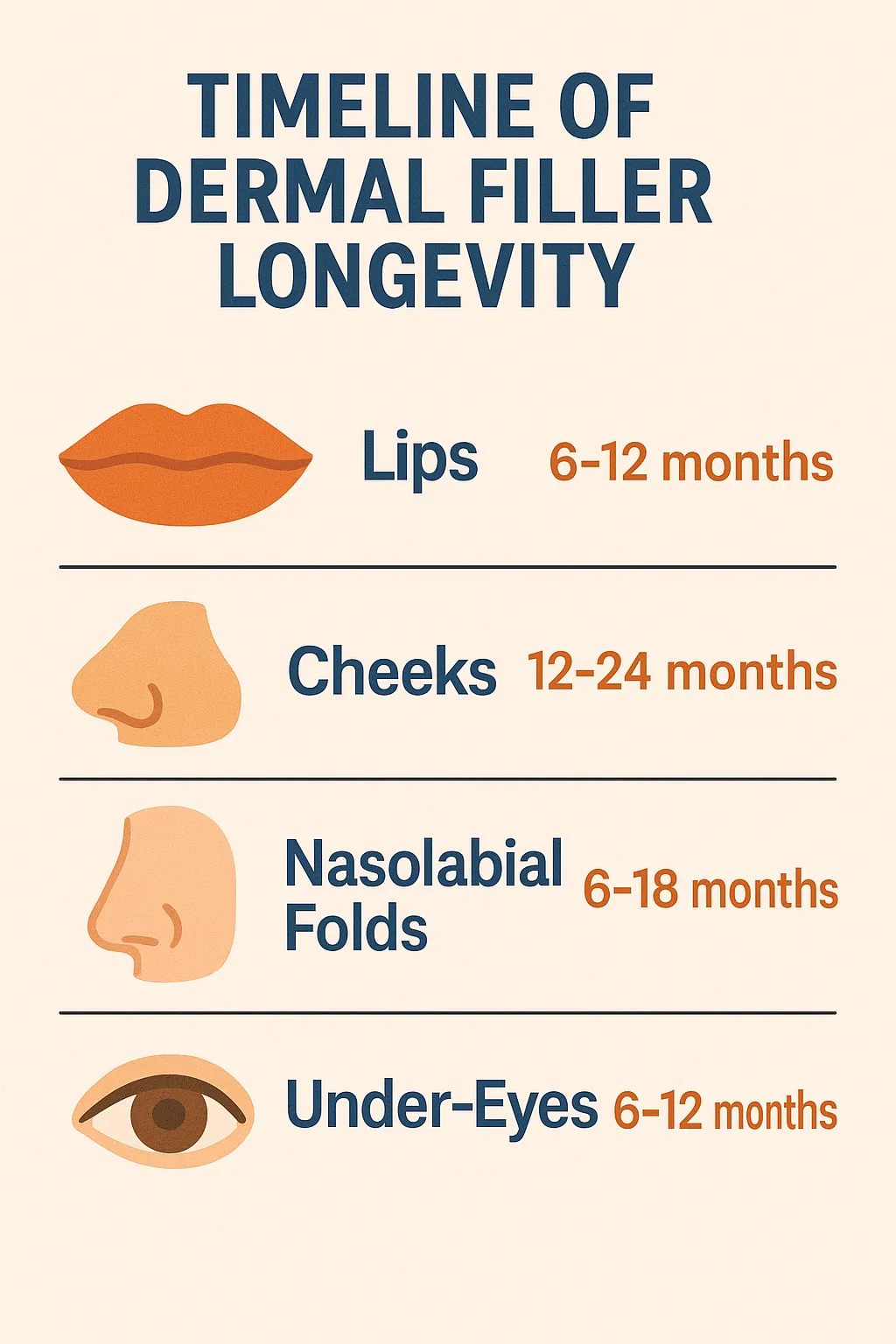
Many of the Restylane® family of products last between 6 to 12 months. Some of the Restylane® family of products may last up to 18 months in a specific area as seen in study results. Sculptra®, however, can last up to approximately 2 years after your series of treatments is complete.
Two Products, Two Timelines
- Restylane®: The Restylane® family of products are hyaluronic acid based gels which are designed to add volume to the area they are placed. Many of them are designed to last between 6 to 12 months. A few of them have proven to last up to 18 months in very specific areas, as seen in studies.
- Sculptra®: Sculptra® is not a gel. It is poly-L-lactic acid and is designed to stimulate collagen in the skin through a series of planned treatments. The results, once the series is complete, can last up to 2 years.
These are important factors to consider during your evaluation. Not only how long they last but also how they work will be a big factor when planning your treatment.
When Does the Clock Start?
The Restylane® family of products provide an immediate effect to the area once injected. Swelling and bruising will be factors to consider immediately after treatments.
Sculptra®, on the other hand, takes several weeks to begin to provide an effect to the area once injected. Most of the effect you will see after injection is due to swelling and the fluid it is mixed with. At approximately a month, you may begin to see the effect of new collagen being produced to the area.
The improvement builds gradually, and we will need to wait until after the series is completed to see the full effect of Sculptra®. Our before and after guide covers the early timeline in the first weeks.
What Decides Where You Land in the Range?
There are many factors to consider. All the factors have to do with the product itself, the amount used, the area they are injected into, the way they are placed and your biology.
The actual formulations of the product also play a role in longevity of the product. Different ways of cross-linking the gel can have an effect. The firmness of the gel does not necessarily determine how long the product will last.
Your biology is an important consideration. Each of us are different. A fast metabolism may not necessarily mean that a filler will not last.
Choosing the right product and the right way to place the product is important to your safety and the predictability of the result.
The hyaluronic acid family of fillers may last between 6 to 12 months in the lips, depending on the product chosen from the Restylane® family and on your biology (anatomy). If you are considering lip augmentation, you may want to consider whether filler or a lip flip is the best option for you. Please refer to our comparison between lip filler vs a lip flip to decide the best choice for you.
How long cheek filler lasts will depend on the product chosen and how it is planned. How deep are your smile lines and why do you feel they are deep? These are all factors to consider when thinking about filler for smile lines.
What Your Habits Can and Cannot Change
- Sun: Ultraviolet light can cause your skin to age faster and cause pigment changes to the skin. Using a sunscreen daily will protect your skin, not the filler.
- Smoking: Smoking can cause your skin to age prematurely and is known to cause delays in healing. It is not known if it will affect how long the filler lasts.
- Water: Water has not been shown to increase the longevity of your filler. The hyaluronic acid in the filler will attract water in the tissue where it is placed. However, drinking an adequate amount of water will help with your general health.
- Metabolism: Your biology will be a factor to consider when planning your filler treatment. However, your metabolism may not necessarily be a factor to consider when considering how long the filler will last.
All of these will help your skin and your healing after your treatment.
How Filler Fades Over Time
We only use temporary fillers: The Restylane® family and Sculptra®. This means that the filler will be absorbed by your body and the effect will slowly diminish over time.

How Upkeep Is Planned
This is important to know when you begin treatment. Knowing that the filler is temporary will mean that you will need to upkeep your treatment at some point.
If you are not considering upkeep of your treatment, it is important to let us know during your initial evaluation. We do not want you to feel as though you need to upkeep your treatment if it is not something you are interested in.
We will ask you to come in for reassessment once the effect of the filler has softened. For the most part, for the Restylane® family, we will see you 6 to 12 months after the initial treatment, depending on the product used. Some products may last up to 18 months in specific areas as seen in studies.
When it comes to Sculptra® we will plan your next treatment at least 3 to 4 weeks apart during the initial series.
We will need to see you to assess your response to the series. This will help determine how long we should wait before having you come back in for maintenance. However, we will need to see you on a regular basis from your first visit to assess your progress.
Before You Book
Some histories delay or rule out filler: pregnancy, breastfeeding, and active infection or inflammation at or near the injection site. So do severe allergies, multiple severe allergies, any past life-threatening reaction (anaphylaxis), and allergy to numbing medicine (lidocaine), bacterial proteins or any filler ingredient.
Others call for individual review first: a bleeding disorder, which rules out some products, or blood-thinning medicine, which only its prescriber should stop. So do autoimmune or connective tissue disease and medicines that suppress or otherwise change how your immune system works. A history of, or tendency toward, raised scars (hypertrophic scars or keloids) rules out Sculptra® and calls for individual review before hyaluronic acid filler.
Tell us about every medicine and supplement you take, including aspirin and other over-the-counter pain relievers. Also tell us about previous filler or facial surgery, a tendency toward excessive swelling and any history of cold sores. The dermal fillers page lists each product's labeling and reasons to wait.
Swelling, bruising, redness, tenderness, pain, itching and temporary lumps are common, often improving over several days to about 2 weeks.
Less common are infection, allergic reactions, prolonged swelling, delayed inflammation, and lumps or discoloration that outlast the usual window. After Sculptra®, small bumps or firm lumps (nodules) can appear weeks or months later; report any of these to us.
Rarely, filler enters or presses on a blood vessel and blocks blood flow, which can damage skin and deeper tissue. It can also cause temporary or permanent vision loss or blindness, or a stroke.
After either filler, keep strenuous exercise, excessive heat, sun and ultraviolet exposure, and extreme temperatures to a minimum for the first 24 hours. After hyaluronic acid filler, continue until redness and swelling have resolved. After Sculptra®, massage the treated area for 5 minutes, 5 times a day, for 5 days, unless your dermatologist directs otherwise.
On darker skin, bruising and early color change from a blocked vessel can look different or be harder to see. Bruising or inflammation can leave dark marks (post-inflammatory hyperpigmentation) that may take months to fade, so careful technique and follow-up matter.
Call 911 or seek emergency care immediately, then let our office know, if you notice any of these signs:
- Unusual or increasing pain
- Skin that turns white, pale, gray, blue, dusky, blotchy or mottled
- Any change in vision
- Drooping or weakness in the face, an arm or a leg
- Difficulty speaking or understanding speech
- Severe headache
- Dizziness
- Numbness
- Confusion
- Trouble walking or loss of balance
- Difficulty breathing
- Swelling of the tongue or throat
- Fainting
Contact our office promptly if you notice any of these:
- Worsening or prolonged redness
- Worsening or prolonged swelling
- Drainage
- Fever
- Cold sore symptoms
- New or enlarging lumps
This article is general education and cannot diagnose you or replace an evaluation.
How Our Team Approaches Filler
Our South Loop practice is part of the Northwestern Medicine Physician Network. We provide evidence-based recommendations on which filler to use, if any, for your concerns. Our filler treatments are all physician directed and planned by a dermatologist.
Questions Patients Often Ask
Does the Body Absorb Every Kind of Filler?
No. Some fillers used elsewhere contain permanent, non-absorbable materials. We do not offer these fillers.
Can Filler Be Made to Fade Sooner?
It varies. If you receive hyaluronic acid filler, we may be able to reduce the amount of filler with injections of an enzyme (hyaluronidase). This may require more than one treatment, and the filler may not always be able to be completely reversed.
Sculptra® cannot be dissolved with this enzyme.
Is the Visit at Two Weeks a Touch-Up?
Not necessarily. After your first hyaluronic acid filler treatment, we will see you back in 2 weeks to check on your progress. We will then recommend further treatment, if needed, which will be a separate treatment.
Can I Time a Touch-Up Before an Event?
Often, yes. We recommend scheduling your treatment (or a touch-up treatment) at least 2 weeks prior to your important event. Swelling and bruising need that time to settle and can last longer.
A Sculptra® series needs more lead time, since its effect builds over several sessions. You should be able to return to light daily activities the same day as treatment.
Talk With Us About Your Next Step
If you are interested in learning more about whether filler may be right for you, we recommend scheduling an evaluation. We will discuss your concerns and provide recommendations for the best treatment plan to help you achieve your goals, including information on any future treatments you may need to maintain your results. You can easily schedule an evaluation or contact us with any questions you may have.
Individual results and duration of results may vary. Outcomes are not guaranteed.