Skin cancer can develop in all skin tones, including your own. In people with darker skin, skin cancer may look a little different than it does in people with lighter skin.
People with darker skin have some protection from sun damage, but skin cancer can sometimes occur in areas not exposed to sunlight. Learn what to look for so you can decide for yourself whether to get your skin checked.
Can People With Darker Skin Get Skin Cancer?
Each of the three main types of skin cancer can develop in people of every skin tone, even those who rarely burn in the sun.
Two of them begin in certain cells near the surface of your skin (squamous cell carcinoma and basal cell carcinoma). The third begins in the cells that make the pigment that colors your skin (melanoma). Melanoma is less common in people with darker skin, but it does occur.
In Black patients, squamous cell carcinoma is described as the most common form of skin cancer. In some Asian and Hispanic populations, basal cell carcinoma is more commonly seen. Some of these skin cancers are not caused by the sun.

What Skin Cancer Can Look Like on Darker Skin
Redness may be harder to see on darker skin, though some skin cancers still look pink or red. Skin cancers may be brown, black, purple, gray or lighter than the surrounding skin. Look for the following:
- A rough patch, a firm bump or a sore: On darker skin, squamous cell carcinoma may look like a rough or scaly patch of skin, a firm bump, a wart or an open sore. Skin cancers may be brown or black on darker skin.
- A shiny dark bump or a sore that keeps coming back: Basal cell carcinoma may appear as a shiny brown, black or blue-black bump or as a pimple-like sore that doesn't go away or comes back after healing. It may not have the pink, pearly bump seen in people with lighter skin.
- A dark patch or streak that changes: Melanomas can appear anywhere on the skin. Look for a dark patch on your palms or soles that seems to be growing or a streak on a nail that seems to be changing. Some melanomas in people with darker skin can look like a bruise that doesn't go away, a wart, a callus or a sore that won't heal. Some melanomas don't have much dark color.
Where to Look: Palms, Soles, Nails and Other Hidden Places
Melanomas that develop on the palms of the hands, soles of the feet or under the nails are called acral melanomas. They may start as flat brown or black patches with an irregular shape that keep growing.
Acral melanomas make up a larger percentage of all melanomas in Black people than in white people. But that doesn't mean Black people are more likely to get this type of melanoma than white people. Acral melanomas are not mainly related to sun exposure, and the reasons they develop aren't fully understood.
Even if you take steps to protect yourself from the sun, be sure to include your palms, soles and nails when you do skin self-exams. Research hasn't shown that injuries or wearing tight shoes can lead to melanoma on the feet.
Streaks that run the length of several nails and don't change are a common and harmless finding in people with darker skin. But be alert to changes in a single nail, even if streaks have been present in your nails for a long time.
Watch for a streak that begins to widen or become uneven, spreads to the nearby skin, or causes the nail to split, lift off the skin, bleed or develop a lump. You can learn more about what to look for when screening your nails for melanoma.
Whether your skin is dark or light, don't forget to look at the skin around your genitals and anus, your scalp and between your toes when doing a skin self-exam. Although the inside of your mouth isn't skin, it's a good idea to look there, too. (The cancers that can develop there are different from skin cancers.)
Squamous cell cancers can also develop within a long-standing burn scar, in a long-standing open wound or in an area of long-standing skin inflammation or scarring from a long-standing skin condition.
Dark Spots That Are Usually Harmless
Most dark spots on darker skin are not skin cancers.
- Small dark bumps on the face and neck: These bumps are called dermatosis papulosa nigra and are simply harmless brown and black bumps that are common on darker skin. A familiar cluster is usually harmless, but if one bump grows unexpectedly, bleeds, becomes an open sore or looks different from the rest, it is best to have it checked.
- Waxy growths that look like they are stuck on the skin: These waxy growths that are stuck on the skin and can be of a darker color are harmless growths that can become dark, thick, and almost look like warts. They are called seborrheic keratoses. If these look like they are changing, it is best to have them checked.
- Dark marks after a rash, breakout or injury: After a rash, breakout, or injury to the skin, sometimes darker skin can have darker marks for a time after the breakout heals. These are called post-inflammatory hyperpigmentation and they may fade with time. If one of these marks looks like it is changing, it is best to have it checked to make sure it is what you think it is.
Some skin cancers, even darker colored basal cell skin cancers, can look like they could be a mole or melanoma, or even a harmless skin growth. Often a careful examination with a hand-held magnifying light can help narrow the possibilities but if there is still a question, the way to know for sure is to take a sample to the lab.
Why Is Melanoma Often Found Later in Black Patients?
What we do know is that when Black patients develop melanoma, they tend to have it found at a later stage and have a worse outcome as a population. However, there are a number of reasons for this and it is not necessarily because of the color of the skin.
One reason is that melanoma occurs in different places in Black patients and many of these places are hard to see. Many of these skin cancers also look like common, harmless skin conditions of the foot, nail, or skin.
Another reason, when interviewing patients and family members of patients with melanoma, is that there is a belief that darker skin is protected from skin cancer. This is likely a communication issue and it is unknown how many patients are delaying seeking care because of this belief.
It is also possible that a lack of images of skin cancers in darker skin for teaching medical students and doctors could lead to later diagnosis but this is unknown. Finally, unequal access to health care due to insurance, income, and the health care system likely play a role in later diagnosis. However, there is a lot that can be done to help find melanoma, and all skin cancers, earlier.
Protecting and Checking Your Skin
Protecting Your Skin
Skin cancer prevention includes sun protection: seek shade, wear protective clothing including a broad-brimmed hat, wear UV-blocking sunglasses, and wear sunscreen. These actions help prevent UV damage and some skin cancers related to sun exposure but cannot prevent all skin cancers and have not been proven to prevent melanoma of the palms, soles, and nail beds. Also, avoid tanning beds.
When selecting a sunscreen, choose one that is broad-spectrum (protects against both UV light types), water-resistant, and has an SPF of 30 or greater. Apply to all unprotected skin.
Approximately an ounce of sunscreen is needed for full body application in an adult, depending on the size of the individual and how much of the body is unprotected. Apply about 15 minutes prior to sun exposure, or per the product directions. Reapply approximately every two hours when outdoors and when getting out of the water, sweating, or towel drying.
There are tinted sunscreens available that may help eliminate the white cast of sunscreens. Additionally, sunscreens with iron oxides help protect against visible light that can deepen dark marks.
Sunscreens can be mineral, chemical, or combination. As long as the sunscreen meets the above criteria, it is a reasonable sunscreen choice.
Checking Your Skin
Do skin checks in bright light with a full-length mirror and a hand-held mirror. Get help from another person to look at your scalp, back and other areas you have trouble seeing.
Be sure to part your hair and look methodically over all of your skin, including in and around your ears, in skin folds, on the palms of your hands and the soles of your feet. Look in and around your nails, your buttocks, the skin of your genitals, and between your fingers and toes.
Ask one of our clinicians how often you need to do skin checks.
Consider taking pictures of a spot of concern. Take a picture showing where the spot is on your body, another showing the spot and the surrounding skin, and a close-up picture of the spot with a ruler next to it.
Take the pictures in good light, make sure they are in focus, don’t use filters, and note the date the pictures were taken and where on your body the spot is. Taking pictures is not a substitute for coming in to see one of our clinicians.
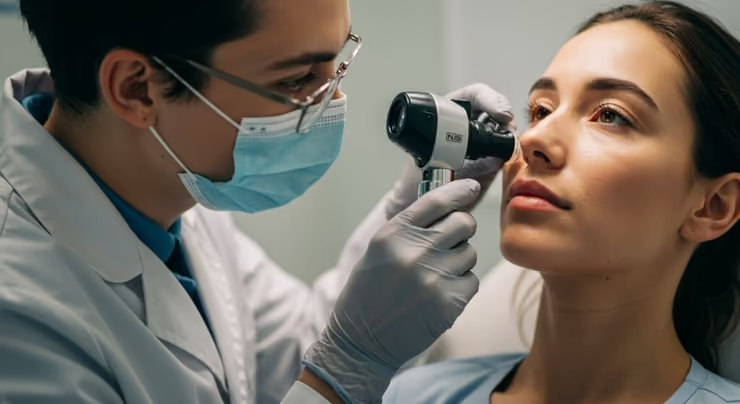
When you come in to see one of our clinicians, they will look at any spots you are concerned about. They may use a small, hand-held magnifying light to get a closer look (this is called “dermoscopy”).
Dermoscopy helps our clinicians figure out what the spot might be and whether or not they need to get a sample of it, but it cannot confirm or rule out skin cancer. The way to know for sure if a skin or nail spot is cancer is to remove it completely or partially and have it sent to a lab to be looked at (“biopsy”).
Skin biopsies can cause discomfort while they are being done. They can also lead to bleeding, bruising, infection, color change in the skin, and scarring at the site of the biopsy. The scar will be permanent, and sampling where a nail grows can leave it ridged, split or misshapen for good, which is no reason to delay checking a changing nail.
Some people develop raised scars over the site of the biopsy (“hypertrophic scars” or “keloids”). Keloids extend beyond the edges of the wound and are more common in people with darker skin. If keloids are part of your history, we plan the biopsy and its aftercare around that with you, alongside a timely answer.
We can do biopsies in our office, either at the same visit as your skin check or at a later visit. Once we get the result of your biopsy, we will contact you to discuss the next steps.
When to See a Dermatologist
If a spot needs a biopsy, tell us beforehand about your medicines, allergies, bleeding problems, pregnancy and any past scarring problems, including raised scars. Make any change to a medicine only with your clinician's guidance.
Contact us promptly, without waiting for a routine check, if you notice any of these signs:
- a new spot that looks unusual to you
- a spot that looks clearly different from your other spots
- a spot that is changing in size, shape, color, height or texture
- a firm, raised bump that keeps growing, including one that is pink, red or skin-colored
- a shiny or dark bump that does not go away
- a pimple-like spot that does not clear
- a spot that itches, feels tender or hurts without a clear reason
- a spot that bleeds, oozes, crusts or scales without a clear reason
- color spreading from the edge of a spot into the skin around it
- a sore that has not healed after three weeks, or sooner if it is growing or bleeding
- a sore that heals and then keeps coming back
- a patch on a palm or the sole of a foot that is getting larger
- a bruise-like mark on a palm or sole that you cannot explain
- a spot on a palm or sole that looks like a wart, callus or blister and does not go away
- a new dark streak in one nail, or one getting wider, darker or uneven, even if your other nails have long-standing, uniform streaks
- dark color spreading from a nail onto the skin around it
- a nail that splits or lifts without a clear reason
- bleeding, a lump or a sore at a nail
- a new lump or growth in an old scar, burn or long-lasting wound, or in skin that has been inflamed for years
- an open sore, bleeding, crusting that keeps returning, or a bad smell in one of those areas
- a sore, lump or dark patch on genital or anal skin that lasts or changes
- a sore, lump or dark patch inside your mouth that lasts or changes, which a dentist or doctor can also check
- a scaly patch, darker or lighter than your skin, that looks like eczema but lasts or does not respond to treatment as expected
- a firm patch or bump that looks like a scar and slowly grows, even if it does not hurt
This article is general education rather than a diagnosis, and it does not replace an examination.
How We Care for Skin of Every Tone
Our board-certified dermatologists examine all skin tones, and we look at places that are often ignored when people talk about sun exposure. If you have questions, we explain everything in plain language. Our South Loop dermatology practice is part of the Northwestern Medicine Physician Network.
Questions Patients Often Ask
Should Everyone With Darker Skin Have a Yearly Skin Check?
Not necessarily. There are a number of factors that go into whether or not you need to see a dermatologist once a year. If you notice anything on the list in the When to See a Dermatologist section above, you should see a dermatologist regardless of how often you get checked.
Is There One Standard List of Seven Warning Signs?
No. There is no single, validated, universally adopted seven-sign rule for skin cancer, and lists online vary. Current cancer-organization advice groups the changes worth checking as practical warnings rather than a score, so you never have to count signs before booking.
The list in When to See a Dermatologist works the same way.
Is Melanoma Always Fatal?
No. While it is true that melanoma that has spread is more difficult to treat, there are a number of very successful treatments to help people in the early stages. Melanoma that has spread can be difficult to treat, but there are modern treatments that help some people.
Every type of cancer has different characteristics, and even skin cancers of the same type act differently in different people. While there are population statistics, you should know that they cannot predict how any individual person will do.
Will Sunscreen Lower Your Vitamin D?
It varies. This is a complex question with a complex answer. Most of the older studies on sunscreen use have found little to worry about.
A recent Australian trial found that people who routinely used high SPF sunscreen had lower vitamin D levels than those who used sunscreen only occasionally. However, that’s only one trial, it left out people with the darkest skin tones, and its result may not apply to everyone.
Vitamin D should be obtained from food sources when possible, and your doctor can help you decide if a supplement is right for you. Talking to your doctor about your diet, supplement use and possibly getting a blood test is a good idea if you’re concerned about your vitamin D level. Getting vitamin D from the sun is not recommended.
Talk With Us About Your Next Step
If you have a spot, streak or even a question that’s on your mind, please make an appointment to see one of our clinicians. Together, we will decide on a plan of action.
Request an appointment or ask us a question today.
Individual results and duration of results may vary. Outcomes are not guaranteed.