Many early warning signs are ones that you can see for yourself. To know for sure, however, you will need to be examined and may need a sample of the spot checked in a lab as well. The kind of skin cancer we’re talking about here starts in the normal, pigment-producing cells of the skin (melanoma).
What Early Melanoma Can Look Like
Early melanomas often have no symptoms that you can feel, so the first sign is often one that you can see. Sometimes melanoma starts in a pre-existing mole, but it often appears in a new spot on the skin where there was not a mole before.
Look for changes in the size, shape, outline, height, texture, or color pattern of a spot. An example of a change in texture is when a flat spot becomes thick, hard, or lumpy.
The change may happen over a period of weeks or months. If you’re not sure whether something has changed, think about what the spot looked like when you first noticed it.
Do you have any new symptoms like itching, tenderness, pain, bleeding, crusting, scaling or oozing from a spot? Keep in mind that these symptoms may have causes other than melanoma, too.
Your risk is higher with previous melanoma, a family history of melanoma or other inherited tendency to get melanoma, many moles or atypical (irregular in shape, edge or color) moles. Exposure to ultraviolet (UV) light, sunburns, use of indoor tanning beds, skin type that tends to burn easily rather than tan and increasing age raise it too.
So does a weakened immune system (due to an organ transplant, certain types of blood conditions, or long-term use of medications that suppress the immune system). You do not need to have any of these risk factors to get melanoma.
The ABCDE Warning Signs
Dermatologists teach ABCDE as a memory aid for noticing a spot worth a closer look rather than as a test.
- Asymmetry: One half of the spot looks different from the other half.
- Border: The edge is uneven, notched, scalloped, blurred or hard to define.
- Color: The color varies within the spot, with different browns or black, or areas of red, pink, white or blue. On darker skin, redness can be harder to see, and a worrying spot may look brown, black, gray, purple or lighter than surrounding skin.
- Diameter: About 6 millimeters, a pencil eraser's width, is still taught, yet melanoma can be smaller, so no one should wait for that size.
- Evolving: The spot changes in size, shape or color, and the American Academy of Dermatology also counts one that looks unlike your others.
Change over time deserves the most attention. A spot that stands out from your others, such as one unusually dark, light or large, is the "ugly duckling." That comparison is yours to make, and such a spot is worth a look even when no letter fits.
What if a Spot Does Not Fit the Pattern?
Some melanomas may not have many of these features, or may appear in places where you are not likely to get sun exposure:
- A firm bump that keeps growing: These melanomas may be fairly symmetrical and have an even color, but they tend to be raised bumps that grow quickly and are usually firm to the touch. They may be dark in color, but they can also be pink or red. They may not have many of the ABCDE features of melanoma.
- Melanomas that have little or no dark pigment: These melanomas can be pink, red, or the same color as your skin. They may be mistaken for a pimple, an irritated patch of skin, or a sore. Lacking dark pigment doesn’t make a growing spot safe.
- Flat spreading patches on the face: These melanomas tend to develop on skin that has had a lot of sun over the years, most often on the face. In the early stages, they can look like age spots. They usually start as flat spots with an uneven tan or brown color that slowly enlarge over time. You should be especially concerned if darker areas develop in these spots or if parts of them become raised.
- Melanomas on the palms and soles: These melanomas often begin as flat, enlarging, irregularly shaped brown or black patches. They may be mistaken for bruises, blisters, warts, or calluses. Some of these melanomas are pink or red or look like sores that do not heal. In people of all skin tones, you should be concerned if these spots change over time or do not go away.
Many people have moles that do not look like melanoma. These moles tend to have even outlines and color, and they change slowly, if at all.
Some people have moles that are irregular in shape or color, but these moles are often not cancer and usually do not turn into melanoma. (People with these types of moles do have a higher risk for melanoma, though.)
Some people also have harmless, waxy, wart-like growths that look like they are stuck on the skin (called seborrheic keratoses). These growths can be brown or black, and some of them can look similar to melanoma.
Flat spots on your skin that are tan or brown become common with years of sun. If one of them is changing, has uneven color or has darkened, we never assume it’s harmless. The appearance of the spot will help your dermatologist decide whether or not to take a sample to have checked in a lab.
Melanoma in the Nails
The main symptom of melanoma of the nail is a new brown or black streak running the length of one nail in an adult. Streaks that are changing, getting wider, darker, have uneven coloring or are wider at the cuticle end of the nail raise more concern.
Melanoma of the nail may also cause splitting, lifting, change in shape of the nail, a lump under the nail, bleeding or a sore that doesn’t heal. Melanoma of the nail can also occur without any dark streaks. When the dark color spreads to the skin around the nail, that’s cause for concern but doesn’t necessarily mean it’s melanoma, as there are other conditions that can cause similar symptoms.
If you injure your finger or toe, it’s common for blood to collect under your nail, and it usually moves toward the end of the nail as it grows, leaving clear nail in its place. Even if you recall injuring your finger or toe or if you see blood under your nail, that doesn’t rule out melanoma, as melanoma of the nail can also bleed.
Other conditions, like fungal infections of the nail, can cause changes in color, thickness and consistency of your nail. Streaks in the nail can also be caused by harmless deposits of pigment.
Harmless pigment deposits often cause similar streaks in several nails that don’t change, especially in darker skin. When only one nail is affected and it’s changing, it’s important to have it checked by a clinician experienced in treating nails.
The way a spot on your nail looks doesn’t tell us what it is, so a clinician experienced in nail procedures may take a sample from the affected area, often where your nail grows. This procedure can permanently change the shape of that nail. Your clinician can send a clipping of your nail to a lab, but it isn’t the same test as a sample of living nail tissue.
Signs Melanoma May Have Spread
Melanoma that has spread may cause lumps either in or under your skin and swollen glands (lymph nodes). It may also cause ongoing pain (including bone pain), a cough that doesn’t go away, trouble breathing, headaches, loss of appetite, tiredness or swelling in your abdomen. Any of these symptoms can be caused by a number of conditions.
If you’ve been treated for melanoma and you develop any of these symptoms, tell the clinicians who are treating you promptly, without waiting for your next scheduled visit. It doesn’t necessarily mean the melanoma has come back.
It’s also possible for melanoma to spread without causing symptoms. Even if melanoma hasn’t spread, it can cause symptoms like itching or bleeding.
The outlook for melanoma that hasn’t spread is much better than for melanoma that has, so a changing spot shouldn’t wait.

What Should You Do About a Worrying Spot?
Make notes about what you’ve noticed is changing and when. Take pictures of the spot at different times, noting the date for each picture.
It helps to take a picture showing where the spot is on your body, a picture of the spot and the skin around it and a close-up of the spot. Place a ruler next to the spot when you can, take the picture in good light, make sure the spot is in focus, don’t use filters and note the date and location.
While pictures can be helpful, they aren’t a replacement for coming in, as there are things we can learn by examining the spot that you won’t be able to see in a picture.
When you come in, our clinicians will examine the spot and ask you questions about it. Coming in to have a spot checked doesn’t mean you’ll automatically have a full skin cancer screening. If that’s something you’re interested in, ask when you come in.
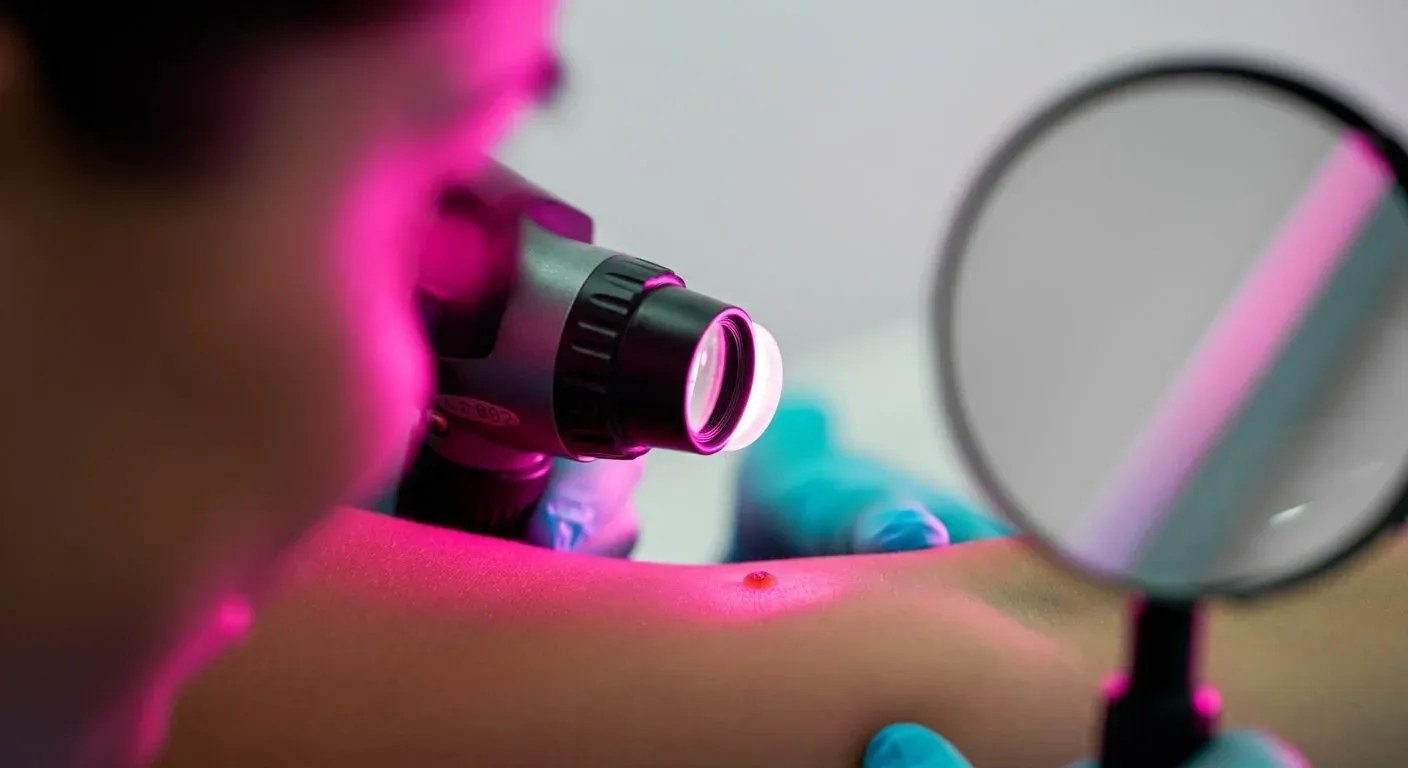
Our clinicians may use a special magnifying light (dermoscopy) to help them decide if they need to take a sample. The light can’t rule cancer in or out. The only way to find out if a spot on your skin or nail is melanoma is to remove all or part of it and have it examined under a microscope in a lab (biopsy).
Not every spot needs a biopsy. When we think a spot may be melanoma, we’ll generally want to remove the whole spot if we can. Like any procedure, there are risks involved: discomfort, bleeding, bruising, infection, change in color of your skin and a permanent scar, which may be raised.
When to See a Dermatologist
Before a biopsy, tell us about your medicines, allergies, bleeding problems, pregnancy and past scarring problems, and change medicines only on your clinician's advice.
Contact us promptly, without waiting for a routine check, if you notice any of the following:
- a new spot that looks unusual to you
- a spot clearly different from your other spots
- a spot changing in size, shape, color, height or texture
- a new or changing spot with any ABCDE feature, even one smaller than a pencil eraser
- a firm, raised bump that keeps growing, even a pink, red or skin-colored one
- a spot that itches, feels tender or hurts without a clear reason
- a spot that bleeds, oozes, crusts or scales without a clear reason
- color spreading from a spot's edge into the surrounding skin
- a sore that has not healed after three weeks, or sooner if it is growing or bleeding
- a sore that heals and then keeps coming back
- an enlarging patch on a palm or the sole of a foot
- a bruise-like mark on a palm or sole that you cannot explain
- a lasting spot on a palm or sole that looks like a wart, callus or blister
- a new dark streak in one nail, or one getting wider, darker or uneven
- dark color spreading from a nail onto nearby skin
- a nail that splits or lifts without a clear reason
- bleeding, a lump or a sore at a nail
- a flat patch on your face that keeps slowly spreading, especially if part darkens or becomes raised
- a new lump in or under the skin
- a swollen gland, such as in your neck, armpit or groin, especially after treatment for melanoma
Call 911 or get emergency care right away at an emergency department for any of these, whether or not melanoma is involved. For the eye signs, an eye doctor can provide that care as well:
- sudden weakness
- sudden trouble speaking
- a first seizure
- severe trouble breathing, such as gasping or being too breathless to speak, whether it came on suddenly or slowly
- sudden flashes of light in your vision
- many new floaters appearing suddenly
- a shadow or curtain moving across your vision
This article offers general education and cannot diagnose a spot or replace an examination.
How Our Team Looks at a Spot
Your care will be provided by a team led by dermatologists who are board-certified and located in our South Loop location. We will carefully examine any spots of concern to you and explain our findings in detail. We will also recommend a biopsy if needed.
Questions Patients Often Ask
Can Routine Blood Work Show Melanoma?
No. There is no blood work that will confirm or deny whether or not a spot on your skin is melanoma. The only way to determine whether or not a spot on your skin is melanoma is via a skin biopsy.
Once you have been diagnosed with melanoma, blood work may be needed for other reasons.
Does Early Melanoma Hurt or Feel Different?
Not necessarily. Most early melanomas do not feel different or hurt.
How a spot feels does not help to determine the stage of the melanoma. The stage is determined by the biopsy results and by later tests, if needed.
Does the Two-Week Rule Mean You Should Wait?
No. This rule comes from England’s health care service and was how quickly they sought to get a patient to a specialist via an urgent referral if cancer was suspected. The major skin cancer organizations in the US do not have this rule.
See the list above under When to See a Dermatologist.
Can Melanoma Start in the Eye?
Yes. When it occurs in the eye, it is referred to as an “ocular melanoma.” It may have no symptoms or cause blurred vision, floaters, and/or a dark spot in your eye that grows larger.
You should see an eye specialist for any new symptoms that occur in your eye. They can examine your eye and take pictures to determine whether or not you have an ocular melanoma.
Talk With Us About Your Next Step
If you are concerned about a spot, please request an appointment or send us a message to talk through your next step.
Individual results and duration of results may vary. Outcomes are not guaranteed.