Softening the folds from your nose to your mouth starts with what made them deepen. In some patients the fold softens because the cheek above it is supported; in others the fold is treated directly. Which of those fits you is the first thing an evaluation settles.
Why Smile Lines Deepen
The creases from your nose to the corners of your mouth (nasolabial folds) are what most people call smile lines or laugh lines.
Skin loses collagen and elastin with age, the two proteins that keep it firm and springy. At the same time the fat pads of the cheeks lose volume and settle downward. That loss of support above the fold is what lets the crease deepen.
Sun exposure breaks down collagen faster, genetics set your starting point, and smoking and significant weight loss add to the loss. Hydration and sleep position get blamed often, and neither is an established cause of these folds.

Two Ways Filler Can Soften the Fold
Think of the fold like a crease in a cushion that has lost some of its stuffing. You can refill the crease itself, or you can restore the cushion above it so the crease has less to sink into. Filler does both jobs, and the evaluation decides which one your face needs.
Placing product along the fold lifts the crease directly. Restoring volume higher in the cheek gives the fold support from above, so it softens without being touched. Many plans do both, and the choice rests on where your face lost support rather than on which method works better in general.
That is why we examine the cheek and the fold together before recommending either approach. Our dermal fillers page carries the product and labeling detail.
Which Filler Is Used for Smile Lines?
We use two products for these folds, and they work in different ways.
- Restylane®: This hyaluronic acid gel adds volume directly where it is placed and binds water as part of holding that volume.
- Sculptra®: This poly-L-lactic acid product prompts your skin to build its own collagen over a planned series of sessions.
Certain Restylane® products are FDA approved to correct moderate to severe smile lines (nasolabial folds) in adults 21 and older. Choosing among them turns on the approved use, how the gel behaves once placed, and the shape of your own face. There is no single best filler for smile lines, only the one that suits your fold, your skin and your goals.

What the Visit and the Weeks After Look Like
Your visit begins with a medical evaluation of the fold, the cheek above it, and your history. Injectable care at our practice is physician-directed, and the plan is set from that examination.
Plan on 45 to 60 minutes for the appointment. The area is cleaned and numbed with a cream, then small amounts of product are placed with a fine needle or a blunt-tipped tube (cannula). A large blood vessel runs up through this fold and along the nose, so placement here calls for detailed anatomical knowledge and careful technique.
What you see afterward depends on the product, and the mirror on day one shows swelling as much as it shows correction.
- Restylane® on day one: The correction is visible right away, and early swelling changes how it looks for the first several days.
- Restylane® at 2 weeks: A check may be appropriate after a first hyaluronic acid treatment, once the swelling has settled.
- Sculptra® on day one: The fullness you see is largely swelling and the fluid the product is mixed in, and it fades over the following days.
- Sculptra® over the series: The real correction builds over several weeks, and each further session waits about 3 to 4 weeks while we assess your response.
If you want to see how those stages look in photographs, our dermal fillers before and after article covers that across the face.
How Long Smile Line Filler Lasts
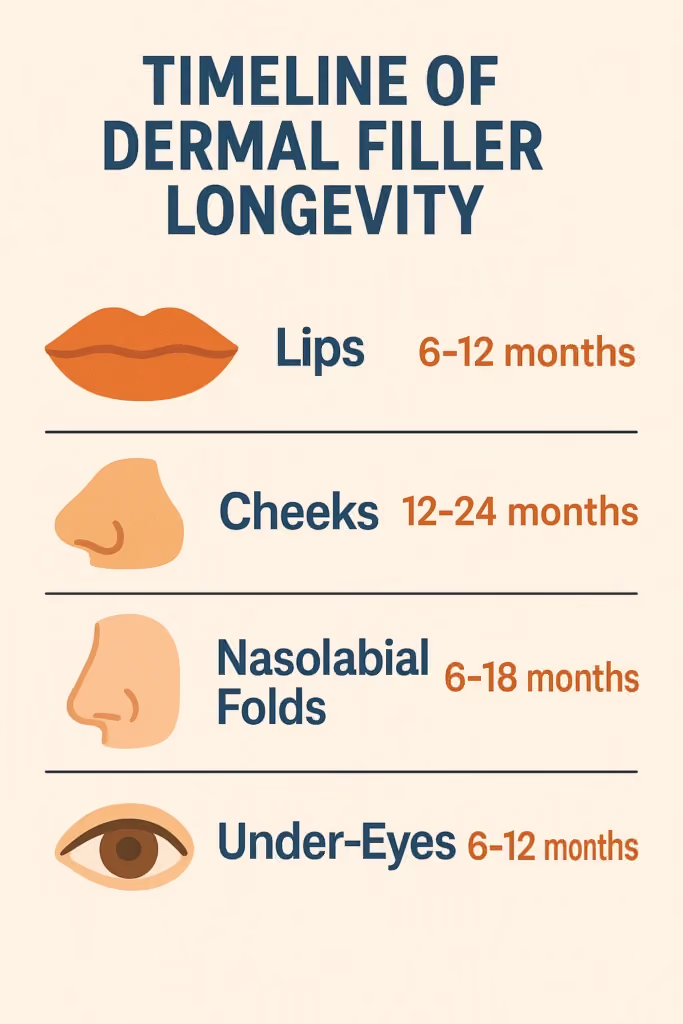
Hyaluronic acid filler in these folds may last about 6 to 12 months, depending on the product, the area and individual factors. Sculptra® builds gradually and has shown effects lasting up to about 25 months in some patients. Our duration guide covers how long fillers last elsewhere on the face.

Where Filler Stops and Other Options Begin
Botox® and Dysport® relax the muscles behind movement lines such as frown lines, and they are not FDA approved specifically for these folds. These folds have several contributing causes rather than volume loss alone, so the two treatments address different problems.
Filler can soften selected mild to moderate folds without surgery, and it does not reposition tissue the way a facelift does. Where the skin has loosened substantially, the honest conversation is a surgical one, and we will say so at your evaluation.
How much filler a plan calls for has no standard answer. Hyaluronic acid filler is planned by the syringe and Sculptra® by the vial and session. The amount depends on the product, your anatomy, the degree of correction and your goals.
Before You Book
Tell us about severe allergies, including any past life-threatening reaction (anaphylaxis), and any reaction to numbing medicine (lidocaine) or to filler ingredients. Tell us also about a bleeding disorder or a blood-thinning medicine, and never stop a prescribed blood thinner unless the prescriber tells you to. A history of cold sores, any previous filler, and any treatment that weakens your whole-body immunity all belong on that list.
We defer treatment during pregnancy and breastfeeding, where safety has not been established. An active infection, inflammation or an untreated rash at the injection site postpones treatment until it has cleared. We withhold Sculptra® where there is a history of raised scars (hypertrophic scars or keloids) or a tendency to form them.
Swelling, redness, tenderness, bruising, itching or small lumps are expected afterward and often improve within 1 to 2 weeks, occasionally lasting longer. Less often, lumps or nodules, inflammatory reactions, knots of inflamed tissue (granulomas), or infection appear weeks to months later, and rarely after that. Filler entering or pressing on a blood vessel blocks blood flow, a rare event that can damage tissue or cause vision loss or stroke.
Call 911 or go to the emergency department, and alert our office, for:
- sudden vision change
- stroke symptoms such as facial drooping or slurred speech
Contact your injector immediately for:
- unusual or escalating pain
- skin turning white, gray, mottled or dusky
Contact our office promptly for:
- persistent or newly developing lumps
- redness
- warmth
- swelling
- tenderness
Reading this is not a diagnosis, and it does not replace an evaluation with our clinicians.
Care That Starts With a Medical Evaluation
Our South Loop dermatology practice is led by board-certified dermatologists and is part of the Northwestern Medicine Physician Network. A medical evaluation comes before any cosmetic plan, we choose products and technique on evidence, and we stay with you through follow-up.
Questions Patients Often Ask
Does cheek filler help smile lines?
It varies. In some patients, support restored in the cheek softens the fold without the crease being treated directly. The evaluation shows whether your face lost volume there.
Does the injection hurt?
Not necessarily. A numbing cream goes on first, and the injections themselves take only a few moments.
Can filler make smile lines look worse?
Yes, if too much product is placed or it sits in the wrong spot, the fold can look heavy or unnatural. That is why we treat conservatively and often build the result over more than one session.
Can I go back to work the same day?
Often, yes. Many patients return to their usual routine right after the visit, and the visible part of recovery settles over the following days. Plan photographs and events with that in mind.
Talk With Us About Your Next Step
If you are still unsure whether the cheek or the fold is the place to start, that uncertainty is what the evaluation is for. We will examine both, talk through your options, and build a plan around your face and your goals. Request an appointment with our Chicago dermatologists, or contact our office with the questions you still have.
Individual results and duration of results may vary. Outcomes are not guaranteed.