Dark circles and hollow areas under the eyes bring many patients to our South Loop office. Some ask whether under eye dermal filler could help them look more rested. The honest answer is that it depends on what is causing the change.
Hyaluronic acid filler may temporarily soften infraorbital hollowing in carefully selected adults. It does not treat every cause of dark circles or under eye bags. Some patients are better served by no treatment, treatment of an underlying skin condition, or surgical evaluation.
Under eye filler is also technique sensitive, and in many situations it is used off label.
Why the Under Eye Area Looks the Way It Does
Under eye hollowing, darkness, puffiness, and laxity can have different and frequently overlapping causes. Appearance alone does not establish that stress or fatigue is responsible.
Lower eyelid skin is thin, but the contour also depends on muscle, retaining ligaments, bone, blood vessels, and fat. Hollows and bags can arise from different combinations of these structures. Infraorbital hollowing may be inherited, or it may become more noticeable with changes in bone, fat distribution, and midface support.
Injected filler adds temporary volume; it does not restore every structural change or simply replace the body’s lost hyaluronic acid.
What Filler Can and Cannot Address
Filler may soften the appearance of a tear trough hollow or the shadow it creates. The degree and appearance of improvement vary, and a natural looking or age reversing result cannot be promised.
Filler may lessen darkness caused primarily by shadowing from a hollow. It does not reliably improve melanin related discoloration, visible vessels through thin skin, or pigmentation from an underlying skin condition. Some patients notice pre-existing pigment more once the contour changes.
In selected patients with mild contour irregularity next to a fat pad, filler may soften the lid to cheek transition. It does not remove protruding fat and can worsen puffiness or fluid retention. Prominent fat prolapse, festoons, substantial skin laxity, or eyelid malposition may call for evaluation by a trained eyelid surgeon instead.
Under eye filler is not a reliable treatment for crepey skin or fine surface lines. Those concerns need a separate assessment, and superficial placement can produce lumps, irregularities, or bluish discoloration.
Botox® is FDA approved for temporary improvement of moderate to severe crow’s feet lines beside the eyes; it does not replace volume. Injection into other lower eyelid areas may be off label and needs separate assessment and consent. OurBotox® and Dysport®page covers that treatment.
FDA Status and Off Label Use
FDA labeling identifies several hyaluronic acid products for infraorbital hollowing, with product-specific minimum ages. Juvéderm Volbella XC, Restylane® Eyelight, and Belotero Balance (+) are indicated for adults over 21, while RHA Redensity Eye and RHA Redensity Eye Lido are indicated for adults age 22 and older. Not every hyaluronic acid filler shares this labeling.
Approved age, injection plane, contraindications, and study results differ by product, and approvals can change. Use of any other filler in this location, including other Restylane® products, is off label. Off label use should be disclosed and discussed with you during the consent process.
Products differ in formulation, gel behavior, and studied injection planes. Selection depends on your anatomy and goals, and no single filler suits every patient.
Who May Be a Candidate
Suitability depends on a complete lower eyelid and midface examination. We look at skin quality, pigmentation, hollowing, fat pad prominence, fluid retention, cheek support, eyelid position, and prior surgery or filler. Some of these features were excluded from the pivotal FDA studies, so results in those patients are less certain.
Treatment is deferred when there is active infection or inflammation in or near the area. Contraindications vary by product. They may include a history of anaphylaxis or multiple severe allergies, or allergy to gram-positive bacterial proteins.
Some products also contraindicate allergy to their amide local anesthetic, such as lidocaine or mepivacaine. Both RHA Redensity Eye formulations list bleeding disorders as a contraindication. Autoimmune disease, immune suppressing treatment, or a history of unusual inflammatory reactions requires individualized assessment.
The safety of these fillers during pregnancy and breastfeeding has not been established. Because treatment is elective, it is deferred during pregnancy, and breastfeeding patients receive an individualized discussion.
Please tell us about blood thinners, supplements that affect bleeding, immune suppressing treatment, severe allergies, prior filler, eye disease, and past inflammatory reactions. Do not stop a prescribed blood thinner without instructions from the clinician who prescribed it.
Not every patient needs treatment. Depending on the diagnosis, options include observation, treating a skin or pigment condition, other skin directed procedures, or surgical evaluation.
What to Expect at Your Appointment
Your visit begins with an examination and a review of your history and medications. Appointment length varies with the evaluation and treatment plan.
After cleansing the area and optional topical numbing, the clinician places small amounts of filler using a fine needle or cannula. Neither a needle nor a cannula eliminates the risk of injury to a blood vessel. The appropriate injection plane depends on the product and your anatomy; current labeling may permit placement under the skin, on the bone, or both.
The clinician may mold the product when appropriate. Do not massage or press on the treated area unless you are specifically instructed to.
Discomfort varies. Topical anesthetic may be offered, and several approved products contain lidocaine. You may still feel pressure, stinging, tenderness, or pain during and after injection.
Recovery and Early Results
Some contour change may be visible immediately, but the initial appearance is not the final result. Swelling and bruising can temporarily alter the contour. Many reactions improve within several days to two weeks, but some persist longer or develop after the initial recovery period.
Follow the product specific aftercare instructions you receive. Some filler labeling advises limiting strenuous exercise, extensive heat or sun exposure, and alcohol during the first 24 hours.
Follow-up timing is individualized. At reassessment, we evaluate your response and fine-tune results when appropriate. Any additional filler is not automatic and may be deferred until swelling and other early effects have fully settled. Persistent or delayed swelling should be evaluated rather than assumed to be normal.
Safety Considerations
Under eye filler is generally well tolerated, but as with any medical procedure, risks exist. Common side effects include swelling, bruising, pain, tenderness, redness, firmness, itching, asymmetry, and visible or palpable product. Delayed reactions are possible, including persistent swelling, nodules, infection, migration, or discoloration.
Delayed inflammation has been reported after infections, illnesses, vaccination, or dental procedures. Lumps can reflect product placement, inflammation, infection, or a granulomatous reaction. A persistent, painful, red, warm, enlarging, or draining nodule needs clinical assessment, not routine massage.
A rare but serious complication is vascular occlusion, which occurs when filler enters or compresses a blood vessel. This can block blood flow and lead to skin damage, visual impairment or blindness, or stroke. Some of these injuries may be lasting despite treatment.
Seek emergency care immediately for sudden vision change, eye pain, or severe and escalating pain. Do the same for pale or dusky skin, facial weakness, trouble speaking, confusion, or severe headache. Alert your injector without delay as well.
Contact our office promptly for worsening redness, warmth, swelling, drainage, fever, or a persistent nodule.
Hyaluronic acid filler should not be described as simply reversible. Hyaluronidase may sometimes reduce filler, but this use is off label, may need repeat treatment, and may be incomplete. It does not undo an established skin or vision injury.
Under eye filler may not be appropriate for everyone. Your provider will review your medical history, allergies, medications, and conditions that may affect healing or bleeding risk.
Choose a licensed clinician with specific training in periorbital anatomy, filler complications, and emergency management. Training may reduce avoidable risk, but no injector or technique makes this procedure risk free.
How Long Results May Last
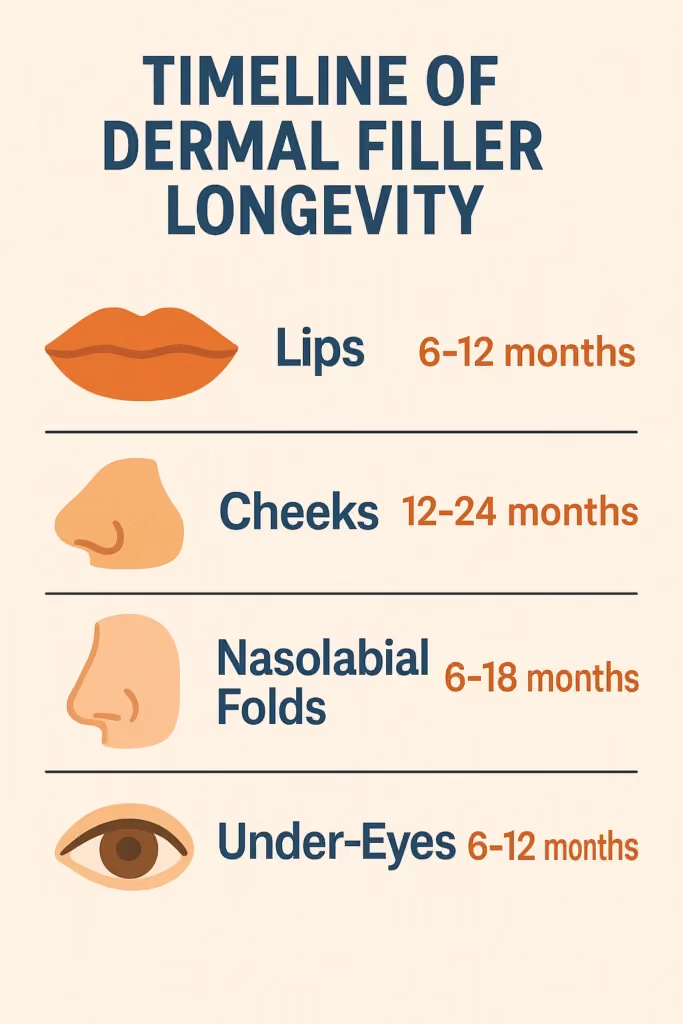
At our practice, filler results last approximately 6 to 12 months depending on the product used, treatment area, and individual factors. In FDA studies, many, but not all, participants still met the study-defined improvement threshold near one year. Visible benefit may fade sooner or persist beyond a year, and residual filler may remain after the visible effect has diminished.
Retreatment should follow an in person reassessment rather than a fixed annual schedule. Some patients seek retreatment around one year, while others need it earlier, later, or not at all. Correction may be partial, asymmetry can persist or emerge, and a touch up is not always advisable.
Before and after photographs show individual outcomes. They do not predict another patient’s result.
Individual results and duration of results may vary. Outcomes are not guaranteed.
Schedule a Consultation
If you are weighing under eye treatment, start with an evaluation rather than a product. Dr. Monica Rani, MD, FAAD and our team examine the whole under eye area and midface before recommending anything.
You can learn more aboutphysician-directed dermal filler careat our practice. When you are ready,request a consultationwith Advanced Dermatology & Aesthetic Medicine in Chicago’s South Loop.