Considering lip filler and unsure where to start? Our South Loop team treats lip injections as a medical procedure, planned around your goals. This page covers what filler can do, how to prepare, and key safety considerations.
Do Dermatologists Do Lip Fillers?
Yes. At Advanced Dermatology & Aesthetic Medicine, lip filler injections are performed by our board-certified dermatologists. That matters because filler injection is a medical procedure, not a beauty service.
Your injector should be a licensed medical professional trained in facial vascular anatomy, product selection, sterile technique, and complication management. Dermal fillers are prescription injectable medical devices, not cosmetic products.
FDA approval applies to a specific product, a specific patient age, and a specific anatomical site. Approved aesthetic filler indications generally begin at age 22. Use below that age, or outside the product’s labeled site, is off-label, and we disclose that before treatment.
For lip treatment, our practice uses Restylane® hyaluronic acid fillers. “Lip filler” is not one uniform material. Ingredients, contraindications, approved sites, and expected duration differ by product, so we identify the exact product in your plan.
You can review the product’s FDA patient labeling with us before deciding. Learn more about our full range of options on our dermal fillers page.
What Lip Filler Can and Cannot Do
Appropriately selected lip filler may temporarily increase volume, enhance parts of the lip contour, or improve selected asymmetries. Results depend on your baseline anatomy, the product, the amount injected, technique, and how you heal. Pre-existing asymmetry may remain, and no particular shape, symmetry, or degree of naturalness can be guaranteed.
Treatment can be individualized to your anatomy and preferences, but the degree of volume, symmetry, softness, and perceived naturalness still varies. Overcorrection, undercorrection, asymmetry, contour irregularity, or dissatisfaction can occur.
Age-related changes can reduce lip volume and definition and contribute to lines around the mouth. In selected patients, an appropriately chosen filler may enhance the lip border or soften certain perioral lines (lines around the mouth). Filler may not prevent lipstick migration, and the skin around the lips is assessed separately with a product appropriate for that location.
You may have seen “lip glossing” promoted online. Small amounts of hyaluronic acid filler may subtly alter fullness or contour. Filler should not be expected to make the lips reliably glossy or shiny.
Technique names like this are marketing labels, not standardized, validated treatments, and comparative evidence for them is limited. The Cupid’s bow may be assessed as part of lip contouring. Chin augmentation is a separate facial-balancing procedure that requires its own evaluation, consent, and product indication.
How to Prepare for Lip Filler
Preparation starts with full disclosure at your consultation so we can design a safe, individualized plan.
Medical History and Allergies
Tell us about severe allergies, anaphylaxis, a history of multiple severe allergies, and any reaction to a prior filler. Restylane® lip products may be contraindicated if you are allergic to Gram-positive bacterial proteins, lidocaine, or other amide-type local anesthetics.
Depending on the exact product, a bleeding disorder may be a contraindication or call for extra caution. Also disclose immune-suppressing treatment and any latex or other allergy relevant to procedure supplies.
Medications and Supplements
Bring a complete list of prescription medicines, over-the-counter drugs, vitamins, and supplements, including Saint John’s wort. Medicines that affect clotting can increase bruising or bleeding. Do not stop prescribed aspirin, blood thinners, or any medically necessary treatment unless your prescribing clinician approves it.
We may suggest pausing selected nonessential NSAIDs or supplements before your appointment. That advice is individualized and product-specific rather than a fixed rule for everyone.
Cold Sore History
Tell us about any history of cold sores, including tingling episodes or outbreaks triggered by past procedures. Lip injections can reactivate oral herpes, and an active or impending outbreak means we postpone treatment.
For patients with a history of cold sores, preventive prescription antiviral medication may be considered after an individualized assessment. Evidence for these protocols comes largely from expert guidance rather than large filler-specific trials.
Prior Filler Disclosures
Disclose any prior or existing filler: the product name if known, the location, and the date. Tell us about past complications and whether any permanent or non-hyaluronic-acid filler remains. Injecting over unknown or permanent filler changes both planning and complication management.
Active Infections and Illness
We postpone treatment during an active viral or bacterial illness. We also postpone when the lips or nearby skin show an active infection or inflammation, including a cold sore, cyst, pimple, rash, or hives. Any new, persistent, or unexplained lesion near the area should be evaluated before injection.
Dental Procedures and Vaccinations
Dental procedures, infections, and vaccinations have occasionally been associated with inflammation near existing filler, so timing is individualized. Some dermatologic-surgery guidance suggests separating dental or other invasive procedures from filler by more than two weeks, although that evidence is limited.
Prior filler alone is not a reason to skip a recommended vaccination. If a vaccine and an elective filler visit fall close together, ask us about timing. When feasible, we adjust the filler appointment rather than delay a needed vaccine.
Safety Considerations
Lip filler is generally well tolerated, but as with any medical procedure, risks exist.
Common Short-Term Effects
Common short-term effects include swelling, bruising, redness, tenderness, firmness, pain, itching, and lumps or bumps. Many of these improve within days to one or two weeks, but some can last longer, so we never promise “no downtime.”
Uncommon and Delayed Complications
Uncommon and delayed complications include infection, cold-sore reactivation, persistent asymmetry or contour irregularity, nodules, granulomas, migration, discoloration, scarring, and allergic reactions. Some reactions can appear weeks, months, or occasionally years after injection.
Vascular Compromise Risks
A rare but serious complication is vascular compromise or occlusion, in which blood flow is reduced or blocked. This happens when filler enters a blood vessel or presses on it from outside. It can lead to tissue death, permanent scarring, vision impairment or blindness, stroke, and, rarely, death. No injection technique eliminates this risk completely.
When to Call Our Urgent Contact Pathway
Call us through our urgent contact pathway immediately for unusual or worsening pain, blanching, or skin that turns white, gray, blue, cool, or mottled. If you cannot reach us promptly, seek emergency medical care.
WHEN TO SEEK IMMEDIATE EMERGENCY CARE
For any vision change or stroke-like symptom, call 911 or go to the emergency department immediately, then notify us as soon as possible. Stroke-like symptoms include severe headache, facial droop, weakness, numbness, difficulty speaking, confusion, dizziness, or trouble walking.
Eligibility and Safety Warnings
Lip filler may not be appropriate for everyone. Safety has not been established during pregnancy or breastfeeding, in patients younger than 22, or in some patients prone to keloid or hypertrophic scarring. These are not always absolute contraindications for every product, but an elective procedure may be deferred after review.
Your dermatologist will review your medical history, allergies, medications, and conditions that may affect healing or bleeding risk. Never attempt self-injection or buy filler online, and avoid needle-free “hyaluron pen” devices. These devices are not FDA-approved and have caused serious, sometimes permanent injuries.
When to Contact Our Office
Call us the same day for worsening redness, warmth, swelling, or tenderness, pus or drainage, fever, or blistering. Also call for an emerging cold sore or a persistent or painful lump. Inflammatory nodules can resemble infection, so do not massage, puncture, or self-treat a lump without instructions from us.
We provide a reliable after-hours contact pathway so you always know how to reach care.
How Long Do Lip Fillers Last?
Hyaluronic acid lip filler produces a temporary visible effect that gradually fades. With some products, remnants of filler may remain in the tissue after the appearance returns toward baseline.
An initial volume change may be visible right away, but swelling can temporarily alter shape and symmetry. The immediate appearance is not the settled result.
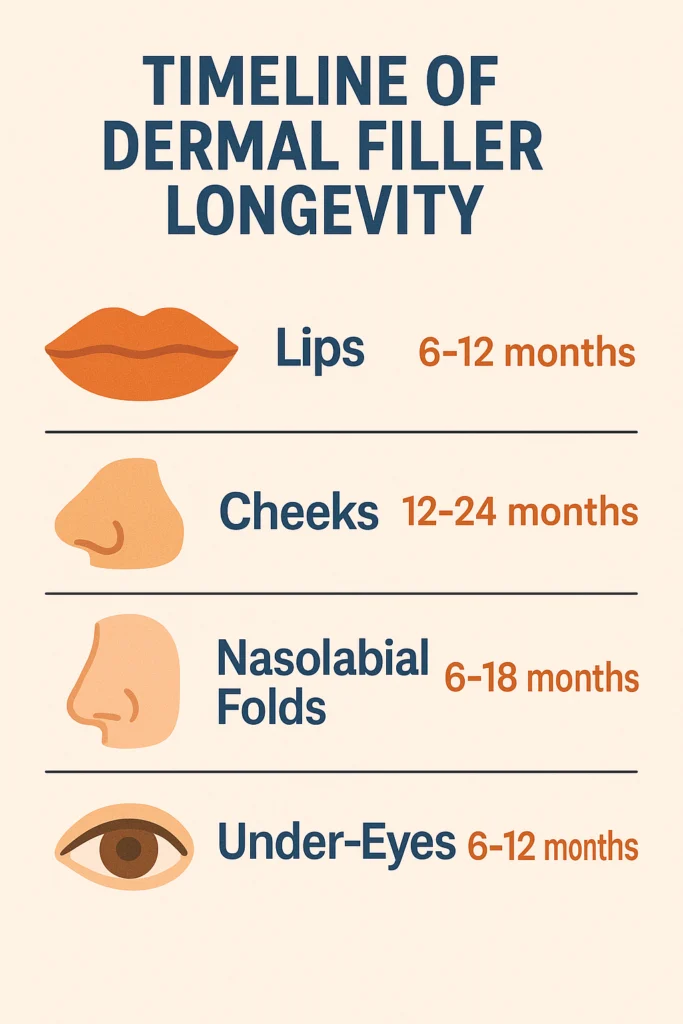
Depending on the specific Restylane® product and the patient, visible improvement may last roughly 6 to 12 months. It can also fade sooner or persist longer. Any maintenance treatment follows reassessment, and the safety of repeated filler treatment over many years has not been established in controlled studies.
Hyaluronic acid filler can sometimes be reduced with hyaluronidase, an enzyme injection. Complete or immediate removal is not guaranteed, repeat treatment may be needed, and hyaluronidase carries its own risks, including allergic reactions.
Its FDA-approved labeling does not include cosmetic filler dissolution, so this use is off-label. Permanent or non-hyaluronic-acid fillers may be difficult or impossible to remove without other procedures.
Schedule a Lip Filler Consultation in Chicago
If you are weighing lip filler, a consultation is the right first step. Our dermatologists will examine your anatomy, review your medical history, identify the specific product that fits your goals, and walk through the risks honestly. Schedule an appointment with our South Loop team, or contact us with questions.
Individual results and duration of results may vary. Outcomes are not guaranteed.
Frequently Asked Questions
Schedule early enough for swelling or bruising to settle before the event. Recovery and settling time vary, and an event-ready appearance by a particular date cannot be guaranteed.
Before-and-after photographs show individual examples only. Results, swelling, symmetry, longevity, and complication risk vary from person to person, and similar results cannot be guaranteed.
Not reliably. In selected patients, filler may enhance the lip border or soften certain lines around the mouth, and the surrounding skin is evaluated separately.